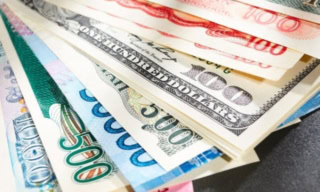
Commercial banks across Pakistan are delaying import-related payments by two to three weeks due to a tightening dollar supply in the market.
This scarcity is largely driven by Pakistan’s upcoming $2.4 billion commercial debt repayments, mainly to China, and stringent foreign exchange reserve conditions set by the International Monetary Fund (IMF).
Banking officials say the delays are affecting both open accounts and contractual imports. Some major importers are facing long waits to clear their Letters of Credit (LCs). Banks are settling LCs at rates higher than the interbank rate. This has widened the gap between the interbank and open market rates.
As of May 30, the rupee’s open market rate approached Rs. 285 per dollar, while the interbank rate hovered around Rs. 282.
The State Bank of Pakistan (SBP) continues to purchase dollars from the domestic market in order to meet the IMF’s Net International Reserves (NIR) target of negative $7.5 billion by the end of June. This follows an end-March NIR of negative $10.2 billion, requiring a $2.7 billion improvement within the current quarter.
Though the central bank has accumulated over $9 billion from the open market in FY2024 and reduced external debt by $800 million, commercial banks argue that the ongoing dollar purchases are straining liquidity and restricting availability for importers.
Banking executives have privately called on the SBP to pause or limit dollar buying to ease the pressure on the market, citing that sufficient remittance and export proceeds exist to meet current import demands. The primary concern, they claim, lies in the financial account, not the trade balance.
Impact on Fuel Prices and Business Operations
Key energy sector players such as Pakistan State Oil (PSO) and Pak Arab Refinery Limited (PARCO) are also facing the heat. In recent transactions, PSO reportedly paid Rs. 3 more per dollar than previous contracts, a cost that could ultimately be passed on to consumers via higher fuel prices.
A senior bank executive warned that although the situation is not as severe as the 2022 dollar crisis, the SBP must act soon to prevent market speculation and maintain confidence.
While the central bank has emphasized the role of a stable rupee in reducing inflation, exporters argue that tight control over exchange rates is hurting their global competitiveness. They urge authorities to allow the market to determine currency values based on supply and demand.
Central bank officials said the seasonal demand spike from Hajj has added to the shortage, but they expect it to ease soon.
The SBP spokesperson declined to comment on several key issues. He did not confirm if there is a $1 billion backlog of deferred import payments. He also gave no details on how the central bank will address the widening gap between interbank and open market rates.
Despite being in an IMF programme, Pakistan has not received substantial foreign loans this time around. The limited influx of funds, combined with the ongoing dollar buying policy, has left banks rationing dollar supplies and businesses bracing for possible ripple effects in the form of costlier imports and slower economic activity.