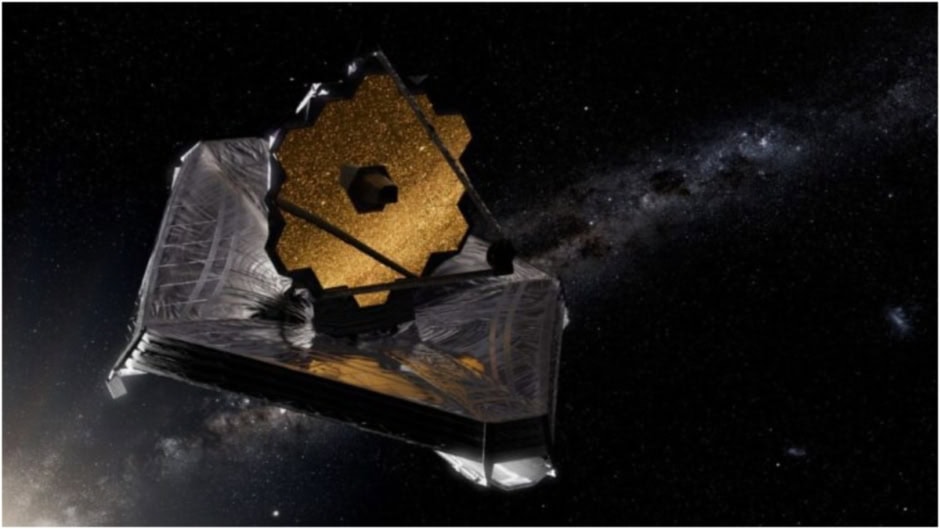
The James Webb Telescope has captured its first direct image of an exoplanet, astronomers announced on Wednesday, revealing a rare glimpse of the newly discovered planet TWA 7b, located relatively close to Earth.
The powerful space observatory, operational since 2022, has revolutionized our understanding of the universe and significantly boosted the search for planets beyond our Solar System. Until now, however, Webb’s advanced instruments were primarily focused on analyzing known exoplanets—studying their atmospheres and compositions—rather than discovering new ones.
The discovery of exoplanet TWA 7b was published in the journal Nature, with France’s CNRS research center calling it “a first” for the James Webb Telescope. Unlike most of the nearly 6,000 exoplanets identified so far—typically detected by the dimming effect they create when passing in front of their stars—TWA 7b was directly imaged.
Overcoming the Challenge of Star Glare
Lead researcher Anne-Marie Lagrange from the Paris Observatory explained that directly imaging exoplanets is extremely challenging due to their faint heat signatures and the overwhelming brightness of their host stars. “We’re blinded by the light of the star they orbit,” she said.
To overcome this, Webb’s MIRI instrument is equipped with a coronagraph, an attachment that blocks out starlight, mimicking a solar eclipse and allowing the telescope’s infrared sensors to spot dim planets nearby.
Using this method, astronomers pointed Webb at TWA 7, a star roughly 100 light-years away. The star, identified by the Hubble Telescope in 1999, is a mere 6.4 million years old and encircled by a massive disc of dust and gas—ideal conditions for planet formation.
Webb detected a bright object within a gap in the star’s second ring, previously observed by Chile’s Very Large Telescope. After ruling out background galaxies or objects from the Solar System, scientists confirmed the presence of TWA 7b— a cold, relatively small exoplanet.
The study revealed that TWA 7b is about the mass of Saturn, making it at least 10 times lighter than any exoplanet previously captured through direct imaging.
The Road to Earth-Like Discoveries
According to Lagrange, the James Webb Telescope’s first direct image of an exoplanet enhances imaging capabilities by a factor of 10, enabling scientists to detect smaller, fainter planets. While gas giants like TWA 7b are easier to spot, the long-term goal is to find rocky, Earth-like planets that could potentially host life.
“We need to study all kinds of planets to understand how planetary systems evolve,” Lagrange said. “Only then can we answer whether our Solar System is truly unique.”
While the discovery of smaller, habitable exoplanets remains a challenge, future telescopes like the Extremely Large Telescope—set to begin operations in Chile by 2028—may bring that goal within reach. For now, the James Webb Telescope’s milestone discovery marks a major leap forward in the quest to explore other worlds.