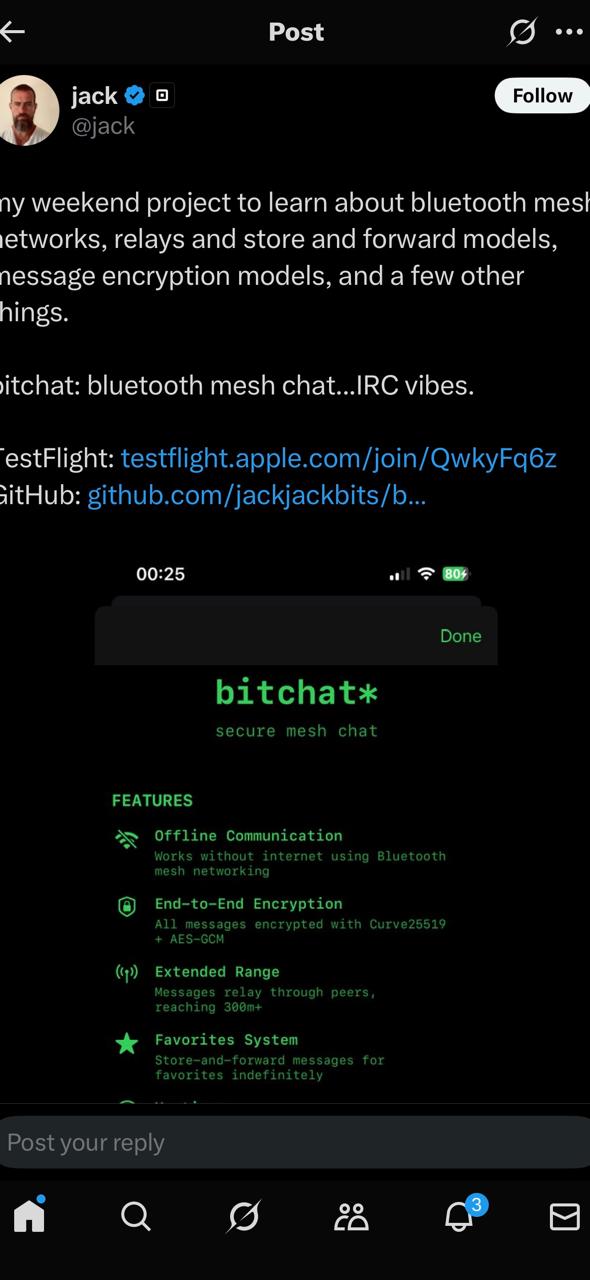
Jack Dorsey, a co-founder of Twitter, created the decentralized messaging app BitChat, which is already in beta testing. Bitchat was created to run over Bluetooth and doesn’t require centralized servers, SIM cards, or the internet. CNBC reports that iOS testers can now access the app through TestFlight. On July 6, Dorsey unveiled the project, describing it as an experimental platform focused on peer-to-peer communication models, encryption, and Bluetooth mesh networks. The software places a strong emphasis on censorship resistance, resilience, and privacy.
Bitchat uses a mesh network, in contrast to conventional messaging services. Bluetooth allows messages to travel between devices, even outside of the usual Bluetooth range. The mesh network grows as users migrate. By serving as connections, “bridge devices” allow communications to travel farther without the need for mobile data or Wi-Fi. By default, messages are encrypted and disappear from the centralized infrastructure.
A New Approach to Secure Communication
Group chats, also known as “rooms,” can be made and password-protected. These rooms let users talk safely and are named with hashtags. The software also has a “store and forward” feature that makes sure messages get to the right people even if they’re momentarily offline. Wi-Fi Direct will also be included in a future update, enhancing connectivity range and communication speed.
Dorsey’s push for decentralization aligns with his support for earlier projects like Bluesky and Damus. He envisions a digital ecosystem where users control their data without relying on corporate infrastructure. In contrast to platforms like WhatsApp or Messenger, Bitchat collects no personal data and stores conversations exclusively on user devices.
The app’s design takes cues from tools used in politically sensitive environments like the 2019 Hong Kong protests, where internet access was limited. With Bitchat, Dorsey aims to offer a platform capable of maintaining communication during government surveillance, internet blackouts, or outages.
Bitchat represents a rising need for decentralized, private substitutes for popular apps. It represents a substantial shift from traditional communication platforms by eliminating dependency on central servers and putting user control at its center.