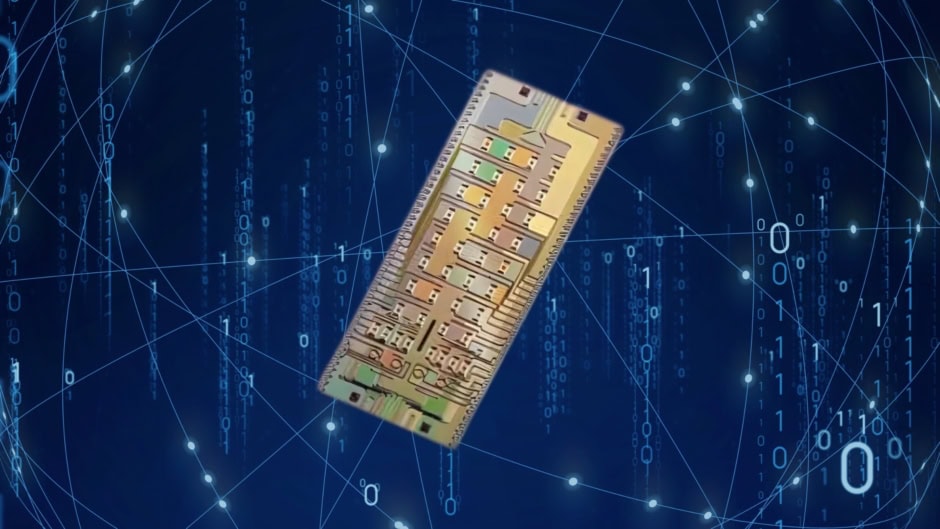
In a major leap toward practical quantum computers, Xanadu and HyperLight have unveiled a record-breaking low-loss AI chip breakthrough. This new photonic chip is one that drastically reduces optical losses and paves the way for scalable, utility-grade quantum hardware. The big deal is that this chip can bring us a step closer to quantum computing than ever possible.
The two companies collaborated to develop a next-gen chip using thin-film lithium niobate (TFLN), achieving unprecedented low-loss performance that beats anything previously recorded in the industry.
How Did Low-Loss AI Chip Came About
The Xanadau-HyperLight partnership successfully dropped waveguide loss below 2 decibels per meter, an astonishing milestone in photonic quantum chip engineering. Even more impressive: the electro-optic switch loss hit a jaw-dropping 20 milli-decibels (mdB), a figure rarely seen in real-world, quantum-ready systems.
These chips were manufactured in a high-volume semiconductor fab, meaning they’re not just experimental prototypes. They’re ready to scale.
Why This Lowest-Loss AI Chip Matters
Photonic quantum computers rely on the precise control and routing of photons. Every bit of loss introduces error, and too much of it cripples scalability.
Waveguides typically suffer scattering and absorption, but this new TFLN-based chip slashes those problems. With ultra-low loss in both guiding and switching, photon signals remain robust across complex circuits.
Low-loss AI chip performance is a massive step toward fault-tolerant quantum computing, a holy grail that remains out of reach for most platforms with our current understanding of computer hardware manufacture.
A Quantum Partnership That Keeps Delivering
Xanadu and HyperLight are not collaborating for the first time. Their earlier collaboration brought us Aurora, the world’s first fiber-networked photonic quantum computer. Built on HyperLight’s TFLN Chiplet™ platform, Aurora demonstrated how modular quantum devices could scale via commercial fiber networks.
Now, they’ve gone a step further.
“This [new photonic chip] result sets a new benchmark,” said Zachary Vernon, Xanadu’s CTO of Hardware. “It brings us closer to delivering utility-scale photonic quantum computers.”
HyperLight’s CEO Mian Zhang echoed the significance, pointing out how TFLN tech is also impacting telecom and datacom. But this specific milestone, he stressed, propels quantum computing timelines forward.