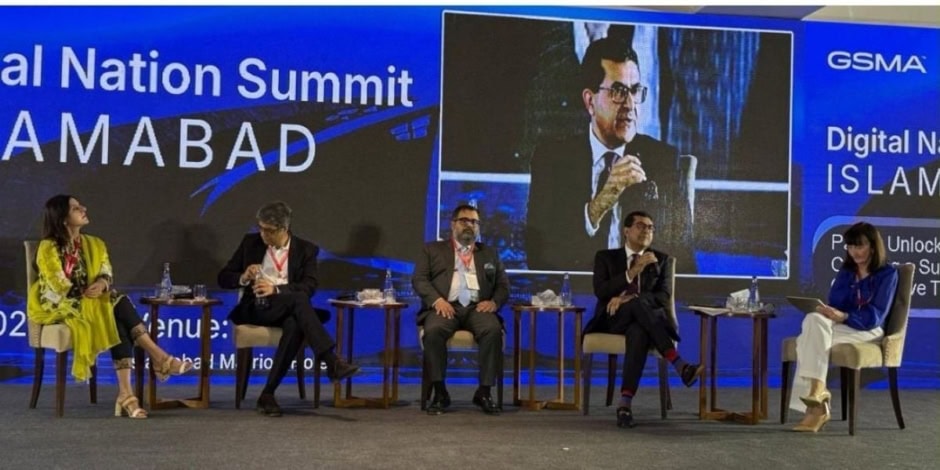
Islamabad hosted the second GSMA Digital Nation Summit on August 7th, bringing together policymakers, telecom executives, tech innovators, fintech leaders, and climate experts at the Islamabad Marriott Hotel.
This event follows Pakistan’s inaugural summit in 2024, which officially ushered the country into GSMA’s Digital Nations series. That foundational event introduced a Digital Gender Inclusion Strategy, published the report Realising Pakistan’s Aspiration to Become a Digital Nation, and underscored transformative telecom growth:
- Mobile broadband coverage expanded from 15% in 2010 to 81% of adults by 2023.
- Smartphone ownership rose to 63%, but only 23% subscribed to mobile internet, highlighting a persistent connectivity gap.
GSMA’s recommended reforms included removing heavy taxes such as the 15% Advance Income Tax and 19.5% sales tax, rationalizing spectrum pricing ahead of the 5G auction, and implementing smartphone financing schemes.
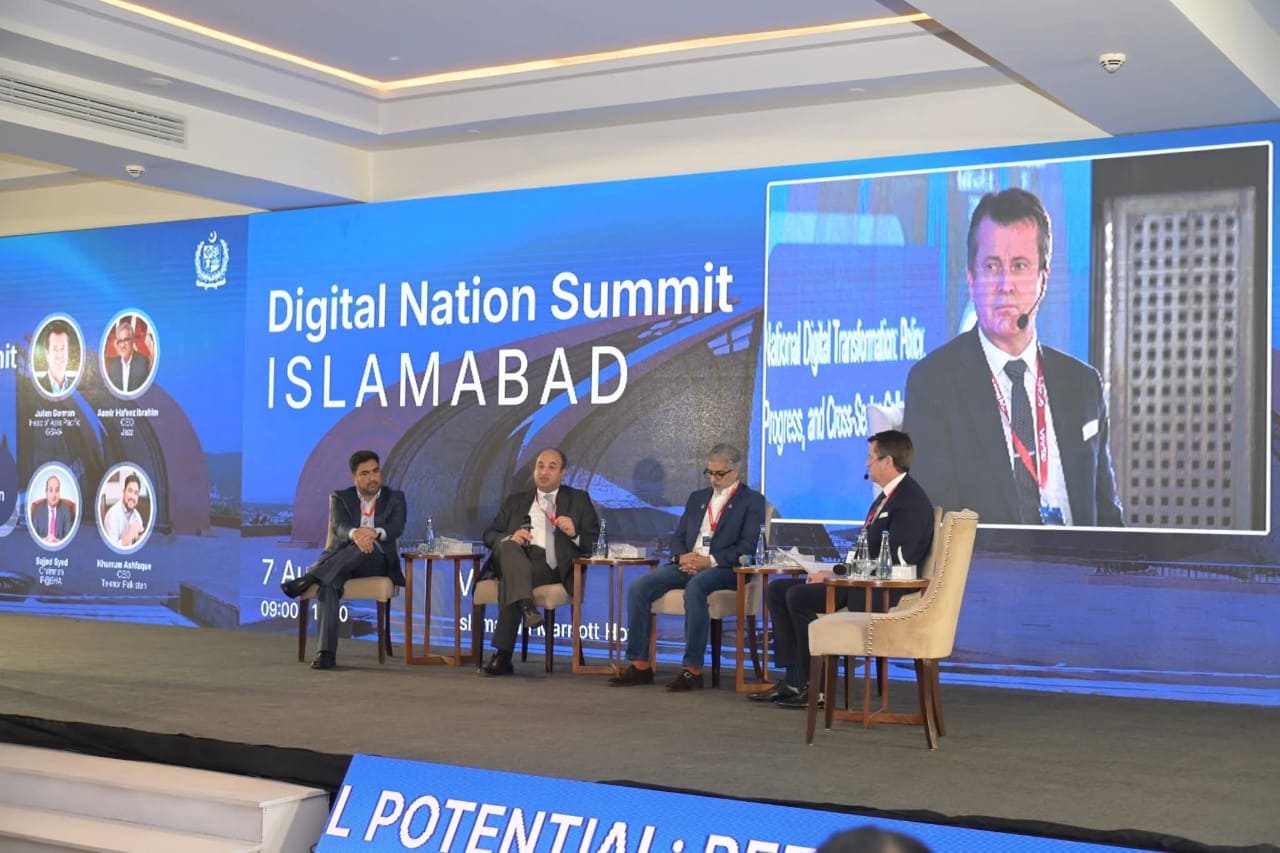
GSMA Summit Pillars: Trust, Infrastructure, Investment & Inclusion
This year’s summit advanced a clear strategic agenda grounded in four pillars:
- Trust by Design: Building secure and scalable public services using GSMA’s Open Gateway standards.
- Climate-Resilient Infrastructure: Ensuring systems withstand environmental stress.
- Investment Enablement: Reforming policies and taxes to attract digital capital.
- Innovation for Inclusion: Extending digital access to underserved communities.
During the summit, the GSMA published “Unlocking Pakistan’s Digital Potential: Reform, Trust, and Opportunity,” a new report highlighting policy opportunities for the country to close one of the Asia Pacific’s most significant mobile internet usage gaps and position Pakistan as a regional digital leader.
Speaking to key decision makers at the GSMA’s Digital Nation Summit in Islamabad, Julian Gorman, the GSMA’s Head of Asia Pacific, detailed the key findings and recommendations from the report. He outlined how mobile technologies and services are transforming Asian economies and can contribute an additional US $1.4 trillion in gross domestic product (GDP) for the region by 2030. However, he raised concerns that Pakistan risks missing out: although 81% of the country’s population is covered by mobile broadband and 68% own a smartphone, only 29% of people used the mobile internet last year, leaving a 52% usage gap – the highest among major regional markets.
“Pakistan has the talent, ambition and vision to be a digital powerhouse, but policy barriers are holding it back,” said Julian Gorman, Head of Asia Pacific, GSMA. “High spectrum prices, heavy sector-specific taxes and regulatory uncertainty are limiting investment at the very moment Pakistan needs affordable, high-quality connectivity the most. Reform is no longer optional – it is essential for economic growth, social inclusion and global competitiveness.”
Key findings include:
- Spectrum allocation opportunity: Pakistan has one of the region’s lowest allocations of IMT spectrum, and its planned 5G multiband auction has been delayed.
- Need for sustainable spectrum pricing: Across the Asia Pacific, spectrum cost-to-revenue ratios rose from 3% in 2014 to 9% in 2023; excessive pricing in Pakistan threatens coverage and speeds.
- Scope to rationalise mobile sector taxation: Combined taxes on mobile usage reach 33%, among the highest in the region, increasing consumer costs and suppressing demand.
- Addressing the mobile usage gap: 52% of Pakistanis live under mobile broadband coverage but do not use it, reflecting barriers of affordability, literacy and trust.
- Gender progress: Women’s mobile-internet adoption climbed from 33% to 45% in 2024 – the largest gain in any country surveyed – showing that targeted efforts can work.
- Addressing rising digital fraud to build trust: Rising digital fraud is eroding trust; Pakistan’s participation in the GSMA APAC Cross-Sector Anti-Scam Taskforce (ACAST) is a positive step, but needs scaling.
Pakistan’s Federal Minister for IT & Telecom, Shaza Fatima Khawaja, said:
“Pakistan is not merely adapting to the digital age; we are shaping it with purpose and precision. Guided by Prime Minister Shehbaz Sharif’s vision, the Ministry of IT & Telecom is advancing a resilient and inclusive digital ecosystem where innovation drives economic growth and technology empowers every citizen.
“We are proud to position Pakistan among 37 nations with a WebTrust-audited National PKI, alongside achieving a 14% improvement in the ITU ICT Development Index. With over 200 million telecom subscribers, 10 million new broadband users, and a 24% increase in internet consumption, digital access is expanding at an unprecedented pace.
“Strategic initiatives such as the launch of AI-enabled data centres and cloud infrastructure, operationalization of 40 Software Technology Parks, deployment of new submarine cables, and 17 telecom projects extending 1,825 km of optic fibre to over 500 underserved areas reflect our commitment to connectivity, innovation, and inclusion. Through these efforts, we reaffirm our mission: to ensure no one is left behind in Pakistan’s digital transformation.”
Thought Leadership from Government and Industry
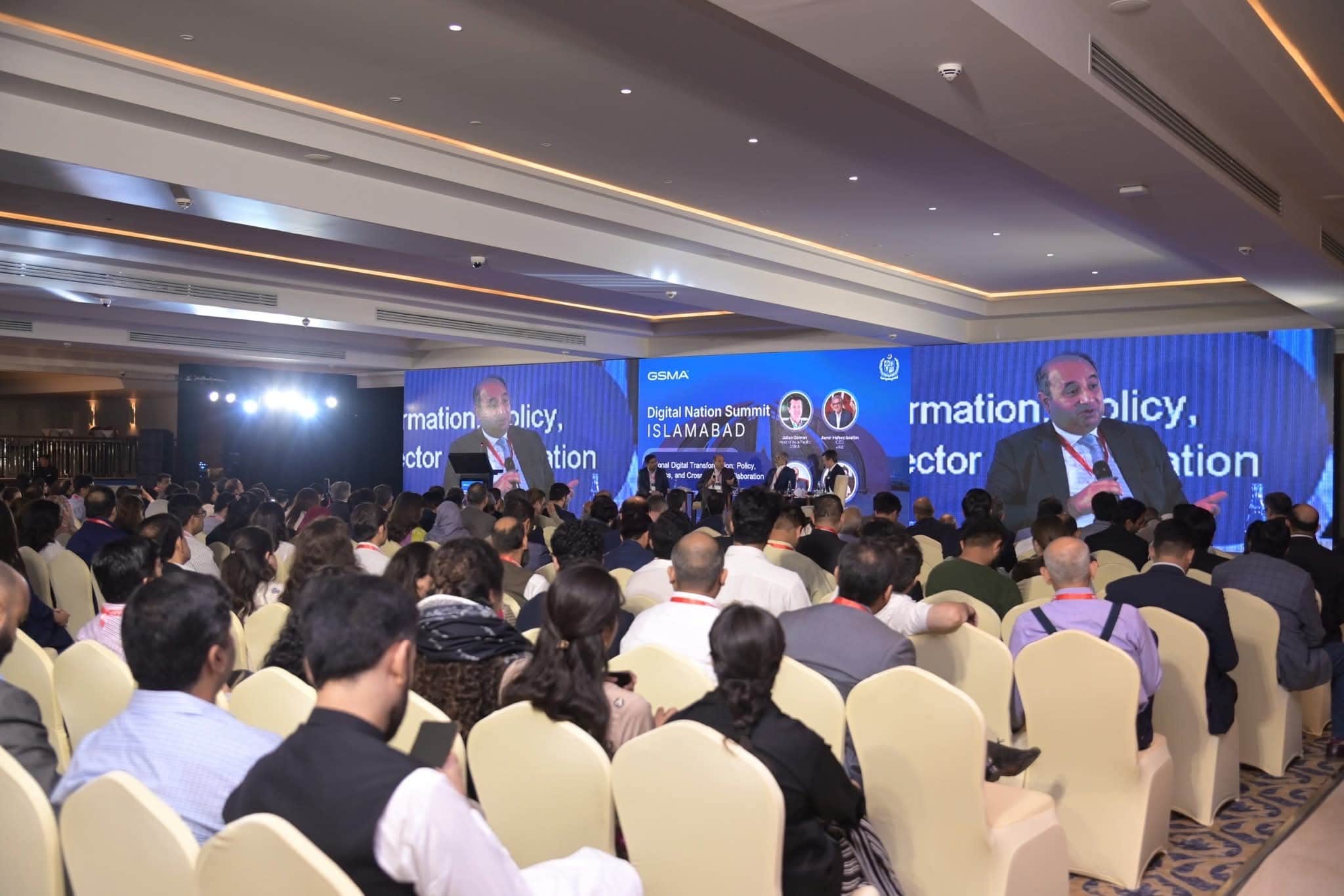
The summit features opening remarks by GSMA leadership, and Highlights included many notable figures, e.g., Maj. Gen. Hafeez Ur Rehman, Chairman PTA and Jahanzeb Khan, CEO of Easypaisa.
As Jazz CEO Aamir Hafeez Ibrahim put it:
“It’s no longer about minutes, but moments and memories. We’ve made an intentional shift towards becoming a ServiceCo to better meet the needs of our customers beyond traditional telecom.”
Chairman PTA stressed:
“Our mandate goes beyond enforcing regulation, we must act as enablers of digital transformation. We are facilitators, not just regulators. […] It is equally our duty to ensure that consumer rights are protected every step of the way.”
CEO of Easypaisa highlighted fintech’s role in a digital Pakistan as:
“We’re at a stage where the necessary infrastructure exists to build a thriving digital payments ecosystem. But to truly accelerate adoption, we must design for trust—embedding security, privacy, ease of use, and reducing friction at every step. A cashless future can only succeed if trust is built into the system from the start.”
Aamir Ibrahim (CEO of Jazz) and Sabahat Bokhari (Founder of The Inclusion Lab) had a stunning fireside chat at the Digital Nation Summit by GSMA APAC. They talked about what it really takes to establish trust in a cashless future.
The session stressed that digital finance must be built on trust by design. This includes working with organizations like the FIA to fight digital fraud and creating payment systems that put privacy, security, and ease of use first.
Platforms are pushing beyond just transactions to build full-stack financial ecosystems that include insurance, lending, savings, and even crypto. These ecosystems are based on long-term well-being, which includes safety, peace of mind, and the confidence to invest in one’s future.
Ehsan Yar Khan, DG Strategy & Development at Pakistan Telecommunication Authority (PTA), said that 606 MHz of spectrum will be offered in the next 5G auction. He explained that for the upcoming 5G auction, PTA has hired a consultant to ensure transparency along with industry input.
GSMA Digital Nation Summit Panel Sessions
- A Vision for Digital Pakistan: aligning national goals with technology
- Connectivity & Infrastructure: planning for 5G, smart cities, and resilience
- Economic Leadership via Digital Innovation: strategies for fintech growth, regulatory reform, and mobile-led exports
- Youth-Led Innovation: incubating startups, enabling API access, and nurturing digital talent
The summit talks will pave way to a Diversity4Tech networking session, promoting collaboration across public and private sectors.
Why It’s Pivotal Right Now
Following GSMA editions in Hanoi and Singapore, Pakistan’s summit places the nation firmly within the Asia-Pacific digital narrative.
With nearly 200 million mobile subscribers, GDP contributions from mobile at billions, and dynamic youth-driven digital exports, the time for inclusive, transparent, and resilient digital reform has arrived.