Engineers Eshel Wasim and Dharsan Srinivasan of the Birla Institute of Technology & Science, Dubai campus, have unveiled Project REBIRTH. It is an innovative AI-driven safety system designed to protect aircraft passengers in otherwise fatal crash scenarios.
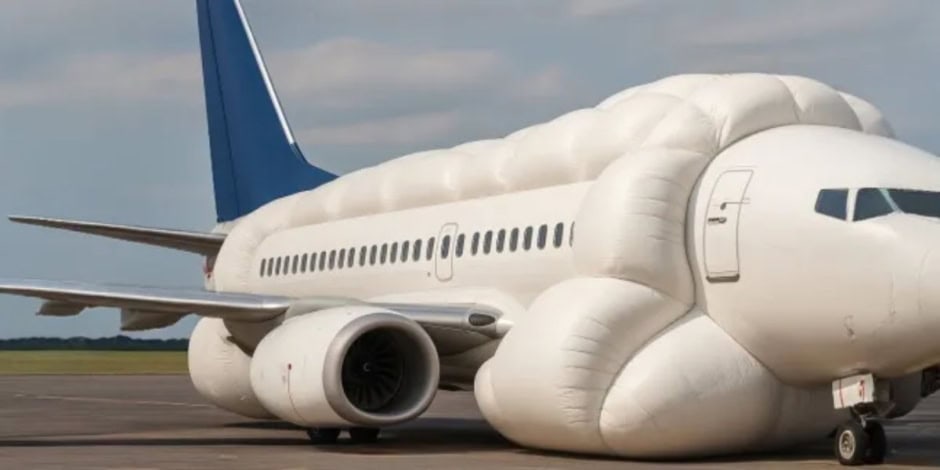
Using AI sensors to detect unavoidable crashes, the system can deploy a cocoon of external airbags in under two seconds to reduce impact forces. Inspired by a recent aviation tragedy, the project has drawn global attention and is a finalist for the prestigious James Dyson Award 2025.
A System Born from Tragedy
The concept for Project REBIRTH was born out of grief following the Air India Flight 171 crash in June 2025, which claimed over 260 lives. The engineers’ motivation shifted from preventing crashes to ensuring survivability when a crash is unavoidable.
The system functions by continuously monitoring flight conditions, including altitude, speed, and pilot inputs. If the AI determines a crash is inevitable below 3,000 feet, a series of defensive measures is triggered. High-speed airbags deploy from the nose, belly, and tail, cushioning the aircraft with layers of Kevlar, thermoplastic polyurethane (TPU), Zylon, and impact-absorbing, non-Newtonian fluids.
Key Features and Rescue Enhancements
Beyond the airbag deployment, Project REBIRTH incorporates several features to boost survivability:
- Deceleration: The system utilizes reverse thrust or gas boosters to slow the aircraft’s descent.
- Enhanced Visibility: After impact, the plane’s shell is coated in bright orange paint, accompanied by GPS, infrared beacons, and flashing lights to aid search and rescue teams.
- Interior Protection: Non-Newtonian fluids are also integrated into cabin walls and seats, hardening upon impact to further reduce injury.
Navigating Challenges to Real-World Viability
Despite its promise, the project faces significant hurdles on its path to commercial viability:
Added Weight: The added mass of the airbags and hardware could reduce fuel efficiency and flight performance.
Aviation safety consultant Jeff Edwards noted that this trade-off might be substantial, given the rarity of the types of crashes the system is designed to mitigate.
- Deployment Accuracy: The AI system requires near-perfect reliability to avoid false deployments that could cause more harm than good.
- Practicality: The cost, complexity, and weight of retrofitting this system onto existing aircraft or integrating it into new designs pose significant challenges.
A Shift in Aviation Safety
Project REBIRTH represents a potential paradigm shift in aviation safety, moving the focus from crash prevention to crash survival. If successful, it could offer a last line of defense in the face of a catastrophic failure.
The project compels the aviation industry to consider difficult questions about the cost of safety, the ethical role of AI in life-or-death decisions, and the practical challenges of integrating such a complex system into commercial aviation. As the concept moves forward, it embodies the emotional and human-driven side of engineering, promising hope for a safer future in air travel.