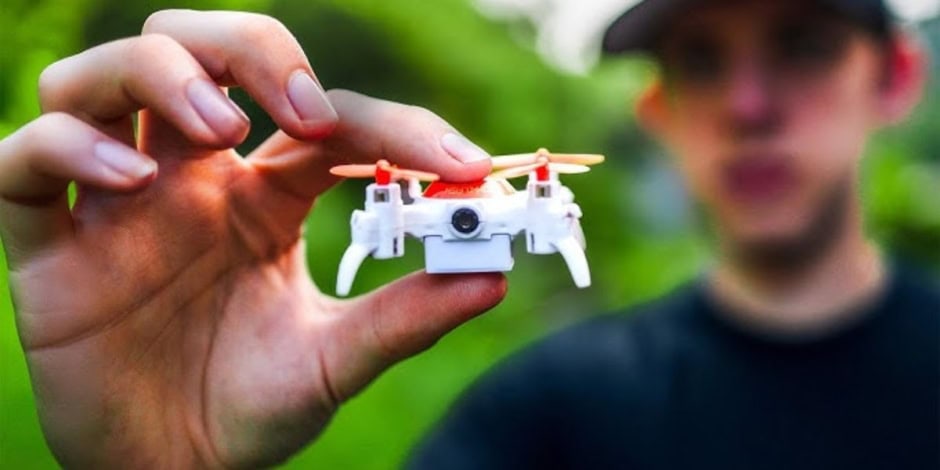
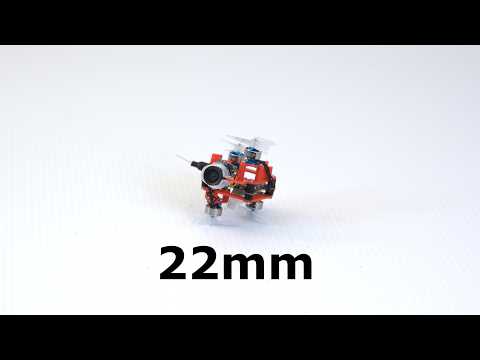
A YouTuber known as Hoarder Sam has engineered what he claims is the world’s smallest first-person-view (FPV) drone, a micro-quad that measures just 22mm from motor to motor and weighs a mere 25 grams. The project, documented on his YouTube channel, highlights a new frontier in hobbyist drone miniaturization, captivating the maker and drone enthusiast communities.
A Functional Marvel at A Microscopic Scale
The project began with the guts of a BetaFPV Air65, a popular micro-quad measuring 65mm. Sam meticulously reconfigured and miniaturized the electronics, motors, and components into a new, smaller frame. The resulting “bone-like” design uses two overlapping propellers on each end to maintain a stable flight pattern.
Despite its minuscule size and exposed propellers, the drone demonstrates surprisingly capable flight performance. It can sustain flights for about two and a half minutes, just 30 seconds less than its larger Air65 counterpart. Its design retains agility and maneuverability, proving that a live pilot perspective can be achieved even at this unprecedented scale.
Technical Challenges and Compromises
While the project is a testament to precision and patience, it comes with inherent trade-offs:
- Weight vs. Power: The balance between battery capacity and flight duration remains precarious. The tiny drone has a short flight time of around two and a half minutes due to limited battery capacity.
- Durability and Flight Dynamics: The lack of propeller guards and the fragile, custom-built frame make the drone susceptible to damage from even minor crashes. Moreover, stability is inherently difficult to maintain at such a small size, especially in a breezy environment.
- Sensor Limitations: The drone’s micro-scale video system has limitations in quality and range due to constraints on the camera sensor and antenna size.
Microdrones: The Broader Context
Hoarder Sam’s project is part of a growing movement in both hobbyist and professional micro-engineering. Academic and military research has long explored insect-sized and flapping-wing micro air vehicles (MAVs).
For instance, a Chinese defense lab showcased a bionic mosquito spy drone measuring 2cm and weighing 0.3 grams. Commercial products like the Norwegian-developed Black Hornet micro-UAV are used by armed forces worldwide for surveillance.
What Comes Next for Hoarder Sam?
For the hobbyist community, the most anticipated next step is the release of build details or open-source designs. This could enable other makers to replicate and improve upon Sam’s work. The project also fuels speculation about potential applications for such micro-FPV platforms, including indoor inspection, tight-space exploration, or cooperative swarm robotics.
However, the technical limitations of flight time, range, and robustness need to be addressed before such projects can transition from proof-of-concept curiosities to practical tools. As battery life and sensor technology continue to improve, the capabilities of microdrones are poised for further enhancement.