France’s defence sector today took a giant leap forward with the unveiling of a drone-mounted laser target-marking system that promises to reshape precision strike warfare on the modern battlefield. The technology, developed by MERIO in partnership with TEKEVER, turns unmanned aerial vehicles (UAVs) into mobile “laser painters,” able to tag targets for missiles or bombs while remaining outside enemy air defences.
Signed at the UAV Show 2025 in Bordeaux, this agreement lays out an exciting plan to incorporate MERIO’s Milvus systems into TEKEVER’s intelligence, surveillance, and reconnaissance (ISR) platforms.
As part of this collaboration, the two companies will be testing, evaluating, and showcasing how Milvus sensors can boost the modular ISR capabilities across TEKEVER’s range of UAVs.
“New exciting project with the French Armed Forces! Laser designation from drones — sounds familiar? MERIO keeps pushing the limits of innovation to ensure mission success,” the company said in a LinkedIn post.
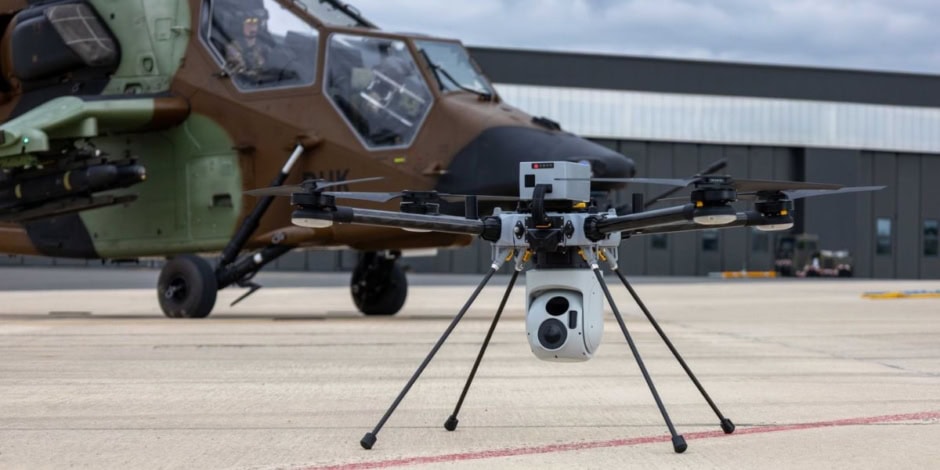
The system equips a combat drone with a high-performance electro-optical/infrared (EO/IR) gimbal and a laser designator module. Once the drone identifies a target, it illuminates it with a laser beam, which is then used by strike platforms (whether aircraft, artillery or naval systems) as a precise guide-point. This allows strikes from safer distances while keeping operators well out of harm’s way.
On the upside, the new laser-marking drone changes the game: smaller, cheaper UAVs can operate as forward designators, dramatically reducing risk to manned platforms and allowing strike units to operate further behind the line. It also speeds up decision loops, shortening sensor-to-shooter time, and paves the way for multiple drones coordinating to cover more ground. Some analysts believe this could catalyse a shift toward swarming strike architectures.
However, there are sharp challenges. The system depends on clear line-of-sight, meaning dust, smoke or weather can degrade laser designation. It also introduces complexity: linking drones, forward sensors and strike assets requires high-bandwidth datalinks and hardened networks. Moreover, adversaries may deploy laser-warning sensors, jammers, or autonomous counter-UAV tactics, reducing effectiveness.
Early test-beds will likely take place within French Armed Forces and select European defence partnerships during 2026. Analysts expect follow-on systems will include longer-range lasers, multi-sensor fusion, AI-enabled target recognition and coordinated multi-drone swarms. Scaling logistics, production and integration across networks will be the real gate-keepers to deployment.