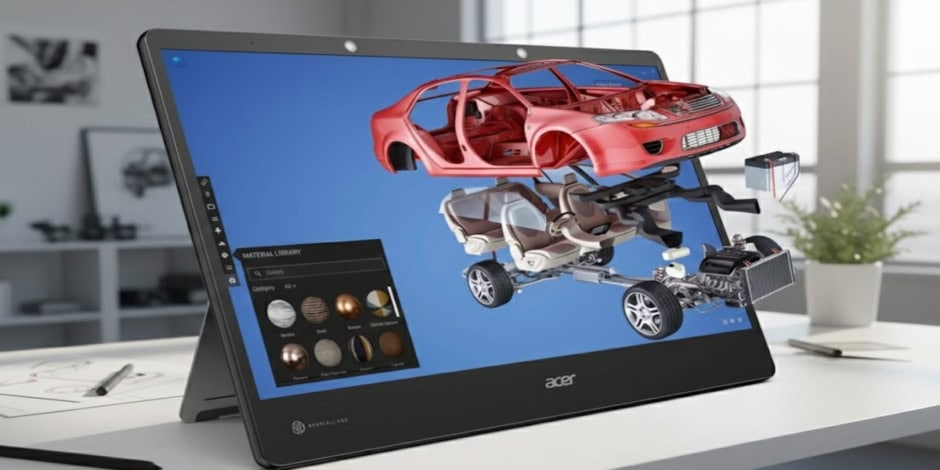
Chinese scientists may have made bulky headsets and clunky glasses go into hiding from the living room for good. The researchers at Shanghai AI Laboratory and Fudan University unveiled EyeReal, a glasses-free 3D display system that tracks your eyes with AI to deliver immersive visuals on a standard desktop screen.
How Does EyeReal Work?
The innovation, announced on December 3, promises to make 3D content as effortless as 2D – no squinting or special gear required. Published in Nature on November 28, the study has already ignited global buzz, with experts hailing it as a “game-changer for consumer tech” amid a surge in AR/VR adoption projected to hit $250 billion by 2028 (as reported by Statistica).
EyeReal works its magic through a stack of three off-the-shelf LCD panels layered with an AI-driven eye-tracking algorithm that adjusts images in real-time. As you shift position, the system recalibrates depth cues, maintaining a 100-degree field of view at full HD resolution. This new development serves as a vast improvement over legacy of 3D tech’s narrow “sweet spot.”
At over 50 frames per second, it handles smooth motion for animations, design previews, and VR-like experiences, all while sipping power like a conventional monitor.
“This isn’t just 3D; it’s adaptive 3D that follows you,” lead researcher Dr. Li Wei said in a Chinese media interview, emphasizing its compatibility with existing LCD production lines for affordability.
Need For A New Tech
The tech’s roots trace to challenges in traditional 3D displays, which often suffer from parallax barriers or lenticular lenses that limit viewing angles and cause headaches. EyeReal sidesteps this with computational rendering. AI revolutionizes the whole processes, getting eye data from a front-facing camera to project personalized parallax. This creates true depth without hardware gimmicks.
Early demos showed users navigating 3D models of ancient artifacts or virtual cityscapes with fluid head turns. Miraculously, they reported no motion sickness. The team shared these demos at the Shanghai AI Lab during the November 30 presser.
Will EyeReal Go Mainstream?
However, this is not the first time China has wowed the world with such tech. Huawei’s Mate 70 Pro (unveiled back in October 2025) integrated similar tech. What sets EyeReal apart is its open-source elements (code on GitHub since December 1) invites collaboration, potentially accelerating adoption.
As AR glasses like Meta’s Orion falter on comfort, desktop 3D could fill the gap for hybrid work and learning. With funding from China’s Ministry of Science and Technology, the team eyes prototypes for CES 2026.
The research was published in Nature.