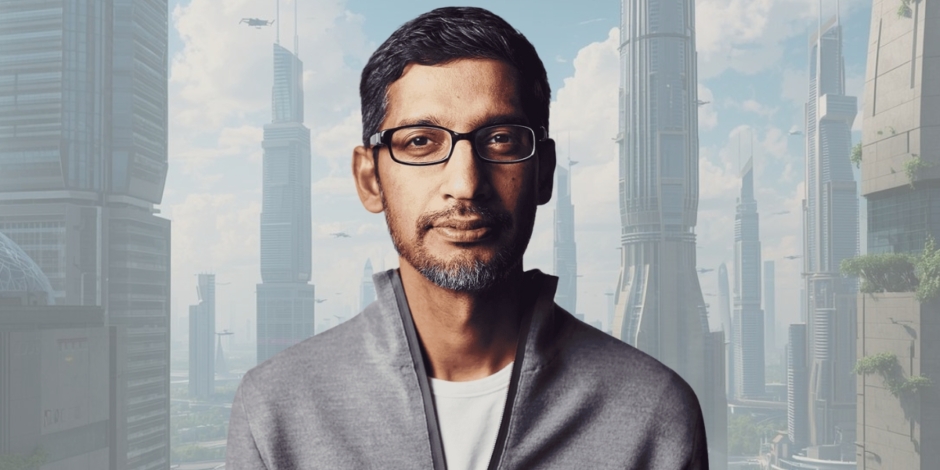
Google Chief Executive Officer Sundar Pichai has issued one of his clearest warnings yet about the disruptive economic force of artificial intelligence, stating that “no job is entirely safe” as AI accelerates past earlier expectations. In a recent interview, he argued that society must prepare for significant turbulence in labor markets as the technology reshapes how people work, learn, and earn.
In a recent BBC interview, Pichai said that “AI is the most profound technology humanity is ever working on, and it has potential for extraordinary benefits, and we will have to work through societal disruption.”
Calling AI “one of the most profound technologies humanity is working on,” Pichai said the coming transformation will touch every professional category.
“It will evolve and transition certain jobs,” he continued. “People will need to adapt, and then there will be areas where it will impact some jobs. So, as a society, I think we need to be having those conversations.”
Pichai’s remarks reflect the broader global debate over job automation. According to recent economic estimates, AI and automation could displace 85 million jobs worldwide by 2025, even as they create 97 million new ones that require different skill sets. Separate studies project that up to 40% of current work tasks across advanced economies may become automatable by the early 2030s.
However, several economists argue that current hiring challenges (such as rising youth unemployment) cannot be attributed to AI alone. Analysts point to hiring slowdowns, economic uncertainty, and policy factors such as tariffs as major contributors to weak entry-level job growth, separate from automation concerns. Some reports show youth unemployment rising beyond typical rates not primarily because AI has replaced jobs, but because companies are cautious about expanding payrolls in uncertain economic conditions.
But a new analysis from a London-based economics consultancy suggests something much more old-fashioned is going on. Companies are simply not interested in hiring.
Since 2023, the unemployment rate for newcomers to the US labor force has surged by over 2.5 percentage points. This stands in stark contrast to older workers, whose jobless rates have remained steady. This insight comes from Dario Perkins, a managing director at Global Data.TS Lombard. Perkins argues the real reason is simply the normal course of business.
He notes:
“For the AI maximalists, this is ‘proof’ that companies are deploying the technology rather than hiring graduates. And it is also consistent with what business leaders are saying, with ‘AI’ now a synonym for ‘cost cutting.’”
Labor market researchers also note that AI is reshaping how hiring is conducted. Automated hiring tools and large applicant pools mean that, for many jobseekers, securing offers requires different strategies and skill sets than in the past, even if overall employment data has not yet reflected widespread displacement.
Major financial firms have documented AI-driven productivity gains even as they continue to assess workforce needs. Other surveys suggest companies may slow hiring for early-career roles as they await clearer returns from AI integration, contributing to uneven opportunities for recent graduates.
Despite these complexities, Pichai reiterated that AI’s impact is not predetermined. He called for renewed emphasis on education and reskilling, arguing that augmenting human skills with AI will be central to future economic success. However, research analysts claim such comments be taken with a grain of salt as they trivialize the reality of the job market.
Economists like Daron Acemoglu say AI’s impact on workers is years away, but tech CEOs counter with a far more urgent message: the shockwave is coming now, and it could reorder the world overnight.