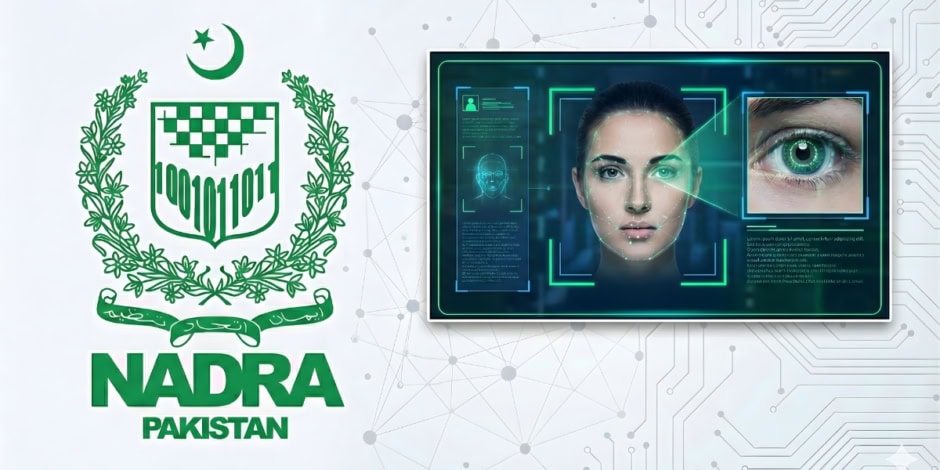
The federal government and NADRA have officially amended the National Identity Card (NIC) Rules to widen the legal definition of biometrics. As of Wednesday, facial and iris scans are now recognised as valid biometric identifiers alongside fingerprints. This amendment, driven by NADRA’s recommendations, lays the legal foundation for a robust multi-biometric verification system in Pakistan.
NADRA has already deployed contactless fingerprint and facial recognition technology. Currently, this system powers online passport applications and vehicle transfers in Islamabad. Furthermore, the authority plans to issue proof-of-life certificates for federal government pensioners using this tech in the near future.
New Protocols Starting January 20, 2026
NADRA will launch a specific fallback mechanism on January 20, 2026, to assist citizens who face fingerprint verification failures. If a citizen’s fingerprint verification fails at a bank, telco, or other service provider, they can now visit a NADRA Registration Centre.
At the centre, NADRA will take a fresh photograph and match it against existing records. Upon successful verification, the authority will issue a certificate containing:
- The purpose of verification.
- Recent and record photographs.
- CNIC number and personal details.
- A unique tracking ID and QR code.
Citizens can obtain this certificate for a nominal fee of Rs. 20. It remains valid for seven days. The relevant institution will then verify this certificate online through NADRA’s system to process the user’s request.
NADRA Solving Hardware & Biological Hurdles
This shift targets a critical flaw in the current ecosystem. Many citizens, due to age or medical conditions, suffer from faded fingerprints. Additionally, service points often utilise substandard fingerprint readers, leading to authentication errors.
Consequently, individuals face constant hurdles at banks, SIM franchises, and housing societies. Although the State Bank of Pakistan (SBP) and Pakistan Telecommunication Authority (PTA) previously issued directives to assist these users, practical challenges persisted. Prime Minister Shehbaz Sharif and Interior Minister Mohsin Naqvi mandated these new measures to provide an immediate resolution.
Mandatory Tech Upgrades for Institutions
NADRA states it is “fully prepared” for the rollout. However, the onus is now on regulators and private sector organisations to upgrade their infrastructure.
- Phase 1: Institutions must upgrade software to integrate NADRA’s facial recognition certificates.
- Phase 2: Service providers must install cameras at counters or integrate them into existing Know Your Customer (KYC) machines.
NADRA explicitly warned that without these upgrades, it cannot provide direct facial verification at service points. If citizens face service unavailability after the January 20 deadline, they are advised to lodge complaints with the relevant institution, as the backend service from NADRA will be fully operational.
Eventually, this facility will expand to e-Sahulat franchises. Following the formal launch of the “Digital ID”, citizens will also be able to access these verification services independently via the Pak-ID mobile application.