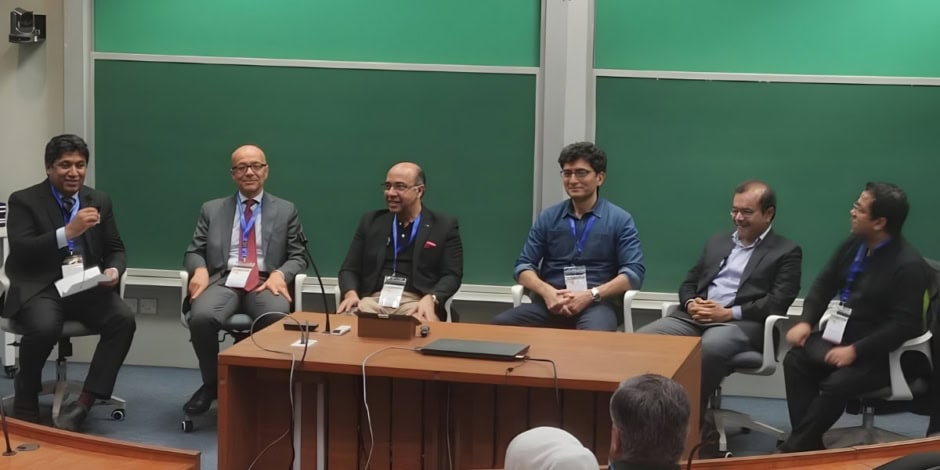
Artificial Intelligence (AI) in Pakistan can offer a massive opportunity for Pakistan’s digital economy, but responsible adoption is the only way to secure it. This was the consensus yesterday at the 13th Asian Management Research Conference (AMRC 2026), organised by the Suleman Dawood School of Business (SDSB) at LUMS.
The panel, titled “AI & the Human Condition”, brought policymakers and tech executives together to face a hard reality, i.e., AI is changing everything. Dr Muhammad Adeel Zaffar, Dean of SDSB, chaired the session, which featured Aamer Ejaz (JazzWorld), Ali Farid (SECP), Asif Akram (Systems Limited), and Dr Maurizio Sobrero (UAE University).
AI in Pakistan: Replacement vs. Reshaping
The discussion revealed a critical divide on the future of work. Ali Farid, Commissioner at SECP, delivered a stark warning. He argued that AI is now replacing human roles rather than just augmenting them. He specifically highlighted sectors like financial research and automated negotiations. Farid urged academic institutions to teach emotional resilience, as students must prepare for career disruption and uncertainty.
Conversely, Asif Akram, COO of Systems Limited, offered a different view. He insisted that automation will reshape jobs rather than eliminate them entirely. However, survival requires action. Akram stressed that companies must invest heavily in reskilling programs and process redesign to remain competitive globally.
The Shift: From Services to Solutions
The panel also addressed Pakistan’s macroeconomic strategy. Yasser Bashir argued that the country must evolve. Pakistan needs to stop acting primarily as a service provider and start creating indigenous AI solutions. This shift requires stronger investment in research, startups, and university-industry collaboration.
Aamer Ejaz, Chief AI Officer at JazzWorld, added that education must align with this new reality. Since AI will automate entry-level roles, foundational skills in mathematics, science, and coding are non-negotiable. He emphasised that educators must train students to ask the “right questions” rather than simply providing “correct answers”.
Ethical Guardrails Required
Experts agreed that innovation cannot happen in a vacuum. The panel underscored the importance of ethical frameworks, liability systems, and professional certifications. These are particularly critical for high-stakes sectors like healthcare, law, and autonomous mobility.
While AI can significantly boost Pakistan’s productivity and exports, the experts concluded that without ethical governance, the benefits will remain limited. Responsible adoption is no longer optional… it is essential for the country’s digital future.