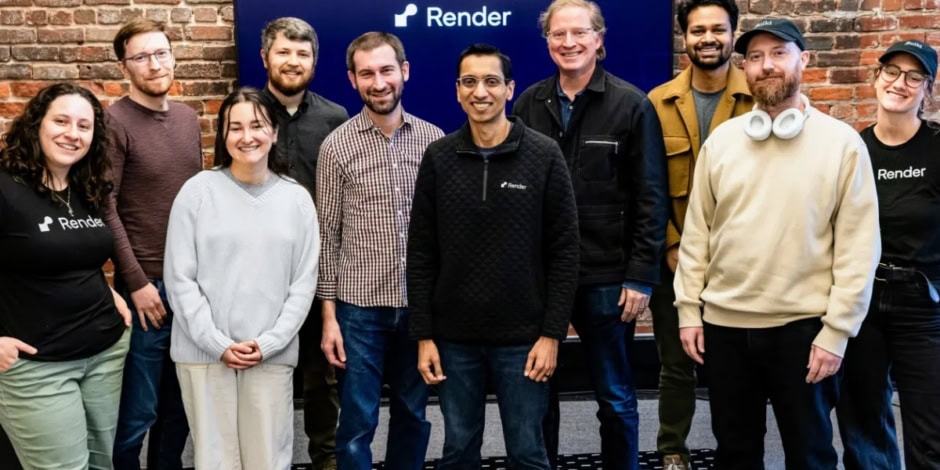
San Francisco-based cloud platform Render has raised $100 million in a Series C extension round, bringing its valuation to $1.5 billion and underlining growing investor confidence in infrastructure tailored for modern AI-driven development, according to company announcements and market reports.
The booming cloud computing landscape, led by giants like Amazon, Microsoft, and Alphabet, has gotten even more competitive since OpenAI launched its ChatGPT assistant in 2022. Companies like CoreWeave, which lease out NVIDIA graphics cards for training AI models, have transformed into thriving enterprises. At the same time, people are turning to AI models to help them write software and are looking for guidance on where to deploy these new programs.
Led by Georgian, Render is piggy-backing on this booming phenomenon. The Render funding round included participation from existing backers such as Addition, Bessemer Venture Partners, General Catalyst and 01 Advisors, raising Render’s total capital to approximately $258 million. Render says the new funds will help it expand its capabilities for supporting AI applications, including a unified runtime environment designed specifically for stateful, long-running workloads common in AI systems.
Render has grown rapidly in recent years, now serving more than 4.5 million developers. They revel in the fact that they get over 250,000 new users joining each month. The platform has become an attractive alternative to traditional hyperscale cloud providers. Particularly for teams that want to deploy complex applications quickly without the overhead of managing infrastructure on services such as Amazon Web Services or Google Cloud Platform. Features such as support for WebSockets, containerized workloads, persistent runtimes and developer-friendly tools have helped expand its appeal among both AI-focused startups and established technology companies.
In comments reported alongside the funding announcement, Render’s founder and CEO Anurag Goel said the company is helping to address a generational shift in cloud usage.
“We get more control over the kinds of things we can do, but the cost basis is just very different,” said Goel in a media interview.
He noted that as AI-assisted coding accelerates the pace of software creation, developers increasingly require tools that allow them to scale quickly without getting bogged down in infrastructure challenges. Messaging around the raise emphasized Render’s goal of becoming a “unified cloud runtime” for AI and agent-centric applications.
“Building these systems on hyperscalers is complex and expensive, while frontend-focused serverless platforms are too limiting for this new execution model,” he writes in a blog.
Before Render came onto the scene, there was Heroku, a true trailblazer in the platform as a service space, built on AWS. Salesforce picked it up for around $217 million back in 2011. Just earlier this month, Salesforce announced that it would be stepping back from rolling out new features for Heroku. Now, Render has begun testing its own hardware infrastructure alongside deployments on major cloud providers. The company and investors say could improve cost efficiency and performance as the business grows.
Clients using Render’s platform include prominent AI and tech companies such as Base44 (also a stakeholder in Render now), Cognition, Luminai, Paradigm and others that are already building production systems on its infrastructure.