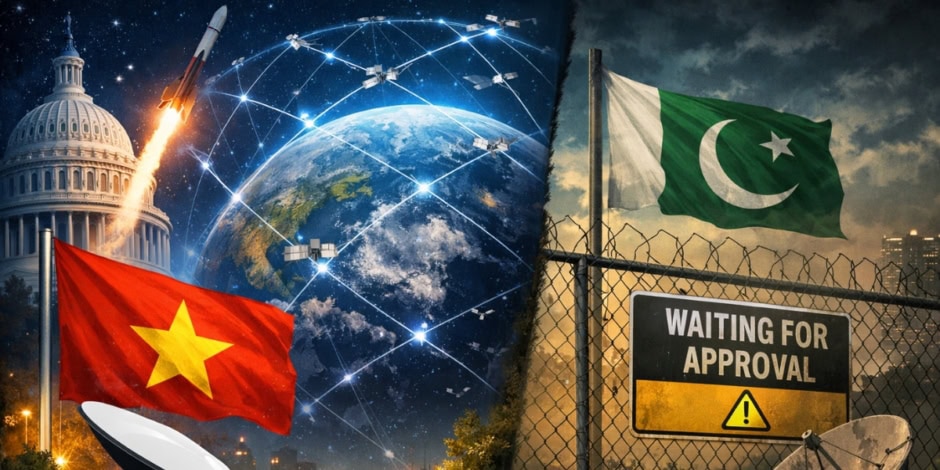
Today is February 20, 2026. Two Prime Ministers flew into Washington, D.C., this week for the exact same global summit. One walked away with a massive tech deal. The other did not. Vietnam’s Prime Minister Pham Minh Chinh successfully secured a formal license for Elon Musk’s Starlink to operate in his country.

Meanwhile, Pakistan’s Prime Minister Shehbaz Sharif is also currently in the US attending President Donald Trump’s inaugural “Board of Peace” meeting. Yet, Pakistan’s long-awaited entry into the satellite internet era remains firmly stuck in the queue.
A Tale of Two Trips
During high-level engagements in Washington, the Vietnamese government formally authorised Starlink Services Vietnam Co., Ltd. to deploy its low-Earth orbit (LEO) satellite network. Hanoi acted pragmatically. They even waived strict foreign ownership caps to make the deal happen.
Conversely, PM Shehbaz Sharif’s US trip has yielded no such breakthrough for Pakistan’s digital landscape. No major deal with any of the tech giants has been cracked during this trip. This glaring contrast highlights a missed opportunity for a nation that desperately needs rural connectivity.
Is Starlink Actually Coming to Pakistan?
If you read previous TechJuice coverage, you know Starlink’s arrival in Pakistan is a massive rollercoaster. The company was first registered in the country back in 2021. Fast forward to March 2025, and the government finally issued a temporary No Objection Certificate (NOC).
At the time, officials promised that formal commercial operations were just around the corner. However, that momentum hit a massive brick wall. Today, the final approval from the Pakistan Telecommunication Authority (PTA) and the Space Activities Regulatory Board (PSARB) remains indefinitely suspended.
The Real Reasons Behind the Delay
Why is Pakistan stalling? The primary roadblock is the state’s fear of losing control over the internet.
Officials cite severe “data security concerns”. Unlike traditional undersea fibre-optic cables controlled largely by the state-backed PTCL, Starlink beams data directly from space. Government regulators fear this decentralised network will bypass Pakistan’s national firewall and monitoring systems. Authorities simply do not want to lose their ability to monitor or suspend internet connectivity during security crises.
Furthermore, international politics plays a heavy hand. A highly publicised recent fallout between US President Donald Trump and Elon Musk has made the Pakistani establishment extremely cautious. Islamabad fears that greenlighting Musk’s company right now might provoke displeasure from the Trump administration. Add in fierce lobbying from Chinese telecom competitors like SSST, and you get a perfect recipe for regulatory paralysis.
SpaceX continues to aggressively expand Starlink’s footprint across emerging markets in Southeast Asia and beyond. Vietnam is actively embracing this digital future. Pakistan, unfortunately, remains strictly stuck waiting in line. Until regulators decide whether they value digital progress over absolute data control, millions of unconnected Pakistanis will keep looking up at a silent sky.