
Whop, the creator and digital commerce platform that has paid out over $2.9 billion to sellers globally, now officially supports Pakistan for payouts. Pakistani users can set up Whop Payments, complete KYC verification, and receive earnings directly to a local bank account in PKR.
Here is the official screenshot of Whop confirming their services for Pakistani users:
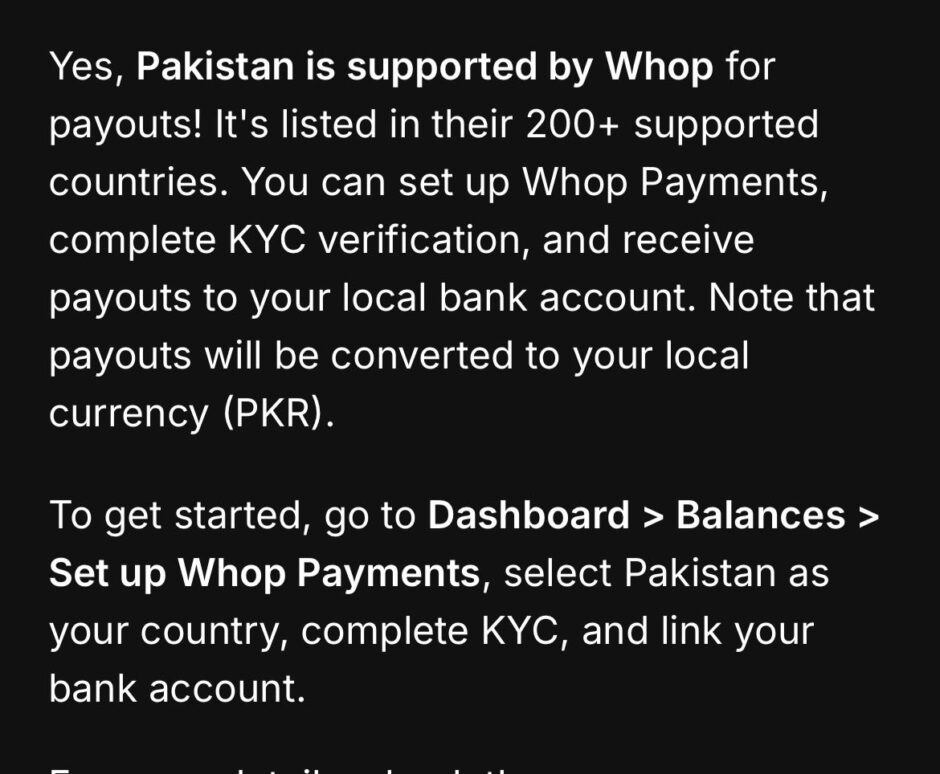
The significance of the announcement is hard to overstate for anyone who has tried to run an online business from Pakistan.
When asked for a direct comment by TechJuice, Whop gave us the following statement:
Whop offers global access across 195 countries and 135+ currencies, so Pakistan is included in Whop’s coverage. Customers in Pakistan can pay using cards, wallets, crypto, and PayPal (which are available globally). However, Pakistan is not listed as having specific local payment methods.
The backdrop of Whop’s availability comes after repeated delays from a government level to help Pakistani freelancers with ease of payments at a global scale. In 2023, Pakistan’s caretaker IT minister confirmed that the government was in active discussions with both Stripe and PayPal, with negotiations being conducted through the Pakistani embassy in Singapore. The minister expressed optimism that talks would conclude within approximately two months. Around the same time, a separate government roadmap for freelancers listed bringing PayPal and Stripe to Pakistan as its top priority.
However, none of those talks produced results. Stripe has mentioned plans to expand into more countries, and there have been occasional reports of Pakistan being on a future roadmap, but no official launch date has ever been confirmed. As of writing this, Stripe does not officially support the country.
Pakistani freelancers, SaaS founders, and e-commerce sellers who want to use Stripe have been forced into elaborate workarounds. These include registering LLCs in the US or UK, obtaining an EIN from the IRS, and setting up virtual bank accounts through services like Payoneer or Wise, all before the money eventually reaches a Pakistani bank account. PayPal, the other major global payment platform, also does not operate in Pakistan.
This has been one of the most persistent pain points for Pakistan’s digital economy. The country ranks fourth globally in freelance growth and has over 2.3 million freelancers, yet its payment infrastructure has not kept pace. Local options like JazzCash, Easypaisa, and bank-based gateways handle domestic transactions but lack the international reach, subscription billing, and developer-friendly features that platforms like Stripe offer.
Whop’s support for Pakistan covers payouts in 241+ territories through its own payments infrastructure, which the company built after outgrowing its original Stripe Connect integration. The platform accepts credit and debit cards, digital wallets, cryptocurrency, and buy-now-pay-later options, with multi-PSP orchestration that routes each payment through the provider most likely to approve it. Sellers can withdraw earnings via local bank deposit, crypto wallet, or through services like Venmo and CashApp where available.
Pakistani users can now use Whop to set up storefronts or checkout links, sell digital products, subscriptions, courses, communities, or software to customers worldwide, and receive payments in PKR without needing a foreign company, a foreign bank account, or a chain of intermediary services.
The development does not solve every payment challenge facing Pakistani entrepreneurs. Whop is a platform for selling digital products and services, not a general-purpose payment gateway that can be embedded into any website the way Stripe can.
But for the growing number of Pakistani creators and developers selling digital goods, it removes one of the largest barriers to participating in the global digital economy.