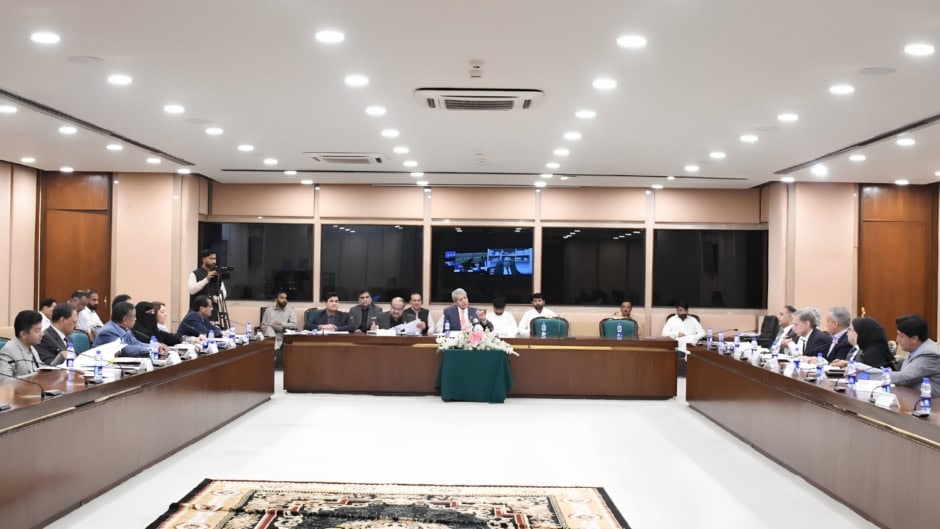
The ongoing Middle East conflict threatens to inflict severe damage on Pakistan’s economy. Annual losses could reach anywhere between $10 billion and $68 billion. This depends entirely on the duration and severity of the war. Economist Ali Salman presented these alarming figures to the National Assembly Standing Committee on Finance on Thursday, April 30.
The National Assembly Standing Committee on Finance and Revenue met under the Chairmanship of Syed NaveedQamar, MNA at Parliament House today.@NAofPakistan @naveedqamarmna#NACommittee pic.twitter.com/7k9N7f9MNJ
— Committees of NA (@NA_Committees) April 30, 2026
The conflict erupted on February 28. Consequently, Iran has essentially closed the Strait of Hormuz. Furthermore, the US enforces a naval blockade to disrupt Iranian oil shipments. By the end of April, the subsequent oil price hike had already forced Pakistan to pay roughly $4 billion in extra external payments. Prime Minister Shehbaz Sharif confirmed that weekly oil import bills have skyrocketed from $300 million to $800 million.
Middle East Conflict: Three Shock Scenarios for Pakistan
Salman outlined three potential impact scenarios for the economy. Normally, Pakistan receives about $3.8 billion in monthly remittances and exports roughly $2.5 billion.
First, the “Current Scenario” assesses the impact of the first 51 days of the war. Pakistan faces an annual loss of $10 billion to $14 billion. Monthly, the country pays an extra $334 million for oil imports and $100 million for freight charges. Meanwhile, exports drop by $400 million, and remittances fall by $333 million. Inflation sits between 10% and 12%.
Second, the “Adverse Scenario” envisions the war lasting three months. Annual losses would climb to $24 billion to $32 billion. Consequently, the monthly oil bill increases by $1 billion. Remittances drop by $700 million, and exports take an $800 million hit. War risk impacts add $150 million monthly. Inflation climbs to 13% to 15%.
Finally, the “Severe Scenario” predicts oil hitting $150 per barrel. Pakistan’s economy would suffer an annual loss of $50 billion to $68 billion. This massive figure equals 17% of the nation’s entire economy. The total monthly impact reaches $5.7 billion. Oil imports surge by $2.8 billion per month. Shockingly, remittances plunge by 40% ($1.5 billion), and exports fall by 50% ($1.2 billion). War risk surcharges peak at $5.7 billion. Ultimately, inflation hits 17%.
For context, Chairman Syed Naveed Qamar noted these predicted losses completely dwarf Pakistan’s current three-year $7 billion IMF programme.
Government Action vs. Economic Reality
Despite these extreme economic threats, the government shows little urgency. The cabinet and legislators agreed to salary cuts. However, this austerity measure saves a negligible Rs. 85 million to Rs. 100 million.
Instead of focusing on crisis management, the Finance Ministry moved a bill to amend the Fiscal Responsibility and Debt Limitation Act. The standing committee approved it. This controversial amendment allows the ministry to appoint an unlimited number of directors to the debt management office. Curiously, the Director General post currently remains vacant.
MNA Sharmila Faruqi objected to these unlimited appointments. Chairman Qamar agreed, stating it should not excuse poor debt management. Furthermore, MNA Hina Rabbani Khar questioned the ministry’s failure to observe the 56% statutory debt-to-GDP limit. Last fiscal year, the ratio hit 70.7%. Minister of State for Finance Bilal Azhar Kayani dismissed the legal limit as merely “aspirational”. Qamar immediately disagreed with this stance.