Meta launched Muse Spark 1.1 on Thursday, a multimodal AI model built for coding and agentic tasks, alongside its first paid developer API. The release pits Meta directly against OpenAI and Anthropic, marking a sharp shift from its open-weight Llama strategy toward charging for model access.
Mark Zuckerberg announced the model on X, his first post there in three years. He called Muse Spark 1.1 a strong agentic and coding model at a very low price, noting it excels at tool use and computer use. Analysts read the timing as deliberate, since posting on Elon Musk’s platform guaranteed wide coverage beyond Meta’s own channels.
(1) Today we're releasing Muse Spark 1.1 — a strong agentic and coding model at a very low price. It's available through our new Meta Model API and in Meta AI.
— Mark Zuckerberg (@finkd) July 9, 2026
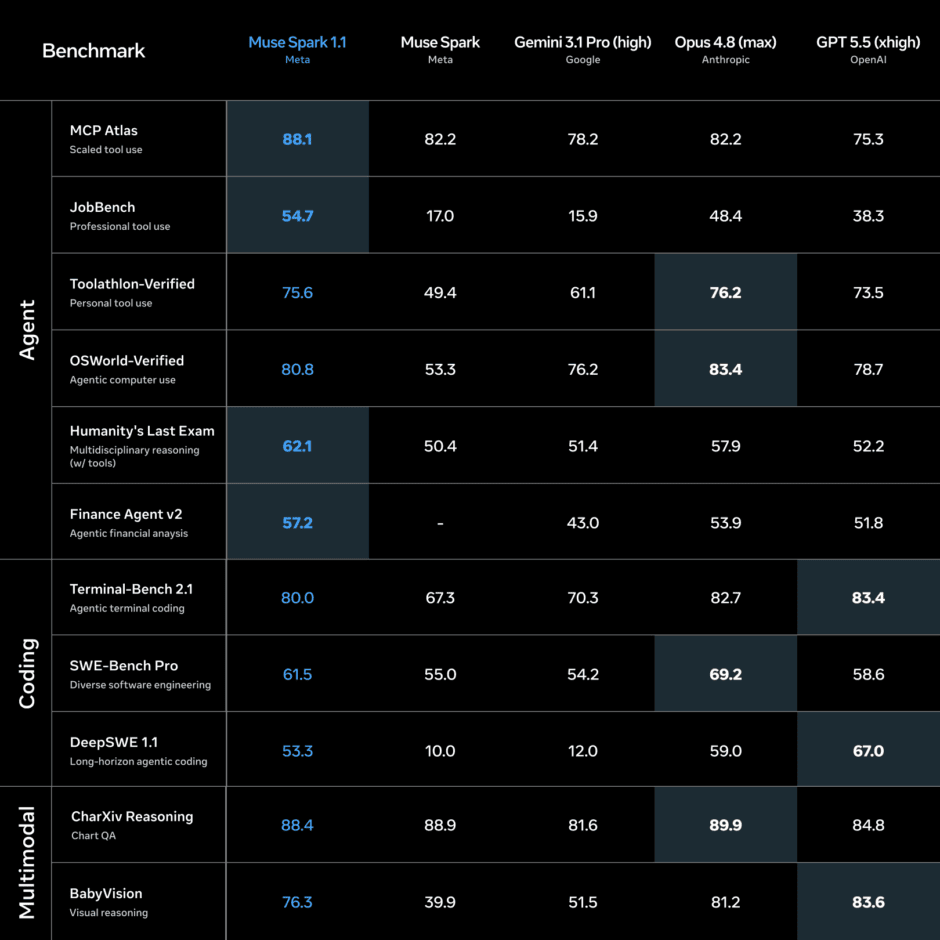
Meta described the model as a multimodal reasoning system built for agentic tasks. It can write and debug code, use software and external tools, and understand text, images, and video. It also carries out complex multi-step tasks with less human input. The model maintains context across sessions and can navigate unfamiliar interfaces with minimal help. Meta says it knows when to automate a task and when to use the interface directly.
Pricing is the sharpest weapon. Developers pay $1.25 per million input tokens and $4.25 per million output tokens, roughly a quarter of rival rates. New API users receive $20 in free credits. Muse Spark 1.1 will also replace the Llama models powering chatbots on WhatsApp, Instagram, Facebook, and Meta’s smart glasses.

As explained by Meta in their official blog post:
Muse Spark 1.1 excels at computer-use workflows that unfold across multiple applications with information changing on-the-fly. It maintains context across extended sessions, adapts to evolving requirements, and navigates unfamiliar interfaces with minimal human intervention.
Rather than reasoning through every desktop step one click at a time, Muse Spark 1.1 understands when to automate and when to use the interface directly. We trained the model to write scripts when automation is faster, click when direct interaction is simpler, and generate batches of actions at each step.
The agentic focus carries risk. Meta plans to replace 90% of its content review staff with AI by end of 2026. Last month, reports revealed Meta’s AI support agents wrongly granted hackers access to roughly 20,000 Instagram accounts. That history raises questions as Meta pushes agents that act on users’ behalf.