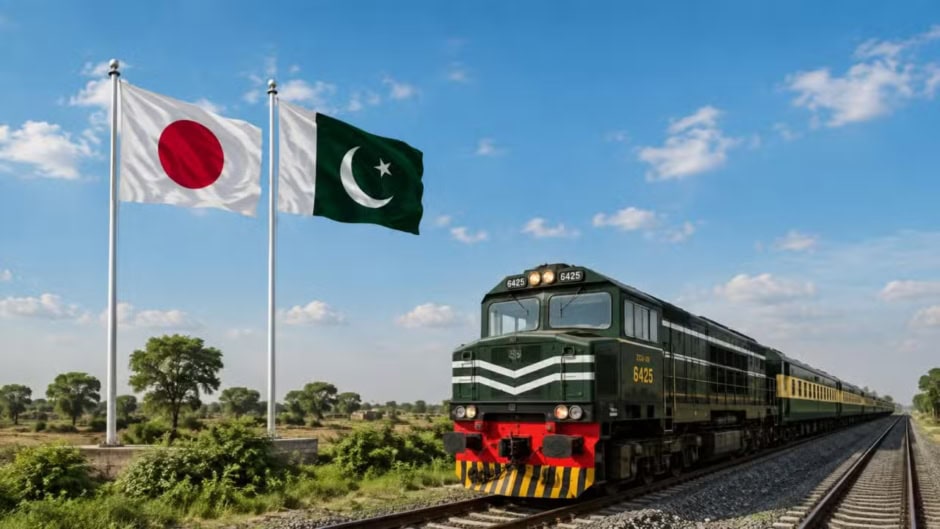
Pakistan has formally invited the Japan International Cooperation Agency (JICA) to co-finance the multibillion-dollar Main Line-1 (ML-1) Railway Project, aiming to strengthen bilateral development cooperation and accelerate the country’s largest railway modernization initiative.
The proposal was discussed during a meeting between Federal Minister for Economic Affairs Ahad Cheema and JICA President Dr. Tanaka Akihiko, who led a high-level Japanese delegation to Islamabad for talks on expanding cooperation in Pakistan’s priority development sectors.
During the meeting, Cheema urged JICA to become a financing partner in the ML-1 project, noting that the Asian Development Bank (ADB) and other international development partners are already supporting the initiative.
He said the modernization of the country’s main railway line would improve Pakistan’s transport infrastructure, facilitate trade, strengthen industrial connectivity, and contribute to long-term economic growth.
Dr. Tanaka acknowledged the strategic importance of the ML-1 project and said JICA would review Pakistan’s proposal. The ML-1 project, a flagship transport initiative under the China-Pakistan Economic Corridor (CPEC), aims to upgrade Pakistan’s primary railway network, improve train speeds, and enhance passenger and freight services.
In addition to the railway project, Cheema sought JICA’s support for workforce development, expanding rural internet connectivity, and conducting feasibility studies for key development projects. He also proposed greater collaboration in preserving Pakistan’s Gandhara heritage sites to promote tourism and cultural exchange.
The JICA delegation welcomed the proposals and said they would be considered as part of Japan’s future development cooperation with Pakistan.
The minister also acknowledged Japan’s longstanding partnership with Pakistan, noting that Japanese Official Development Assistance (ODA) worth approximately $11.7 billion over the past seven decades has supported projects in transport, energy, agriculture, water resources, health, education, industry, and security.
Both sides agreed to continue close coordination to further strengthen Pakistan-Japan development cooperation and explore new opportunities for sustainable economic growth and infrastructure development.