OpenClaw 2.0 has arrived, marking the most significant update yet to the open-source AI harness that turns powerful language models into autonomous workers. Since users can message these agents through channels like Telegram, iMessage, WhatsApp, and Discord, OpenClaw gained viral popularity earlier in 2026. However, this release fundamentally reorients the project toward teams, shared infrastructure, and enterprise workflows.
Creator Peter Steinberger and his co-developers announced the update over the weekend, officially naming it v2026.8.1. The release transforms OpenClaw from a personal harness that developers run locally into something an entire organization could deploy across its workforce. Steinberger described building it as using the product to build itself, spending two months migrating his team toward a shared agent environment.
Two months ago, we started the mission to “build OpenClaw with OpenClaw,” and bit by bit, we moved everyone from using their local coding harness to using https://t.co/mXvAd5PJFA – our shared agent that knows what everyone’s working on and orchestrates it all.
Multiplayer coding… https://t.co/oBL2BMJk2V
— Peter Steinberger 🦞 (@steipete) August 31, 2026
The dominant model for AI coding agents has generally been individual, with a developer running an agent in a terminal. OpenClaw 2.0 pushes toward something different, since agent sessions can now become persistent workspaces that outlive a single terminal or employee. Colleagues can share these sessions, execute them across cloud workers, and supervise them through a browser, complete with session ownership and participant attribution.
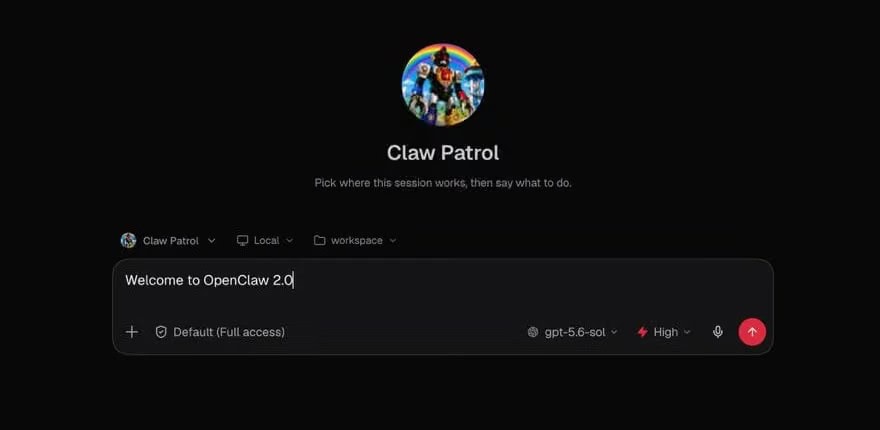
The rebuilt Control UI sits central to this strategy, making conversations the primary interface while deliberately mirroring ChatGPT, Claude, and Gemini. This lowers a crucial barrier to enterprise adoption. Because a shared agent can act with broader organizational authority, OpenClaw 2.0 responds with granular controls, tying approvals to specific requests, commands, and individuals across multiple permission levels.
These changes sharpen OpenClaw’s rivalry with security-focused alternative NanoClaw, which places container-based isolation at its architectural center. However, OpenClaw’s sandboxing remains off by default, assuming a trusted single operator.
Notably, this is an OpenClaw Foundation release, not an OpenAI product, despite Steinberger joining OpenAI in February 2026. Ultimately, OpenClaw 2.0 does not make deployments secure by default, but it makes enterprise-grade configuration far easier than before.