
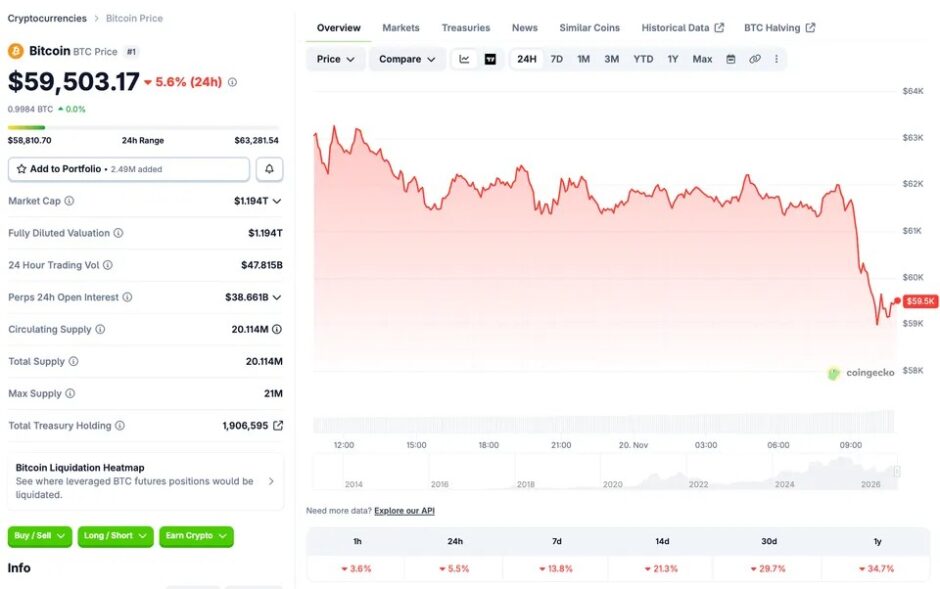
Bitcoin fell below $60,000 on Friday for the first time since July, extending its recent decline as a broader selloff in US technology stocks put pressure on cryptocurrencies and other risk-sensitive assets.
The world’s largest cryptocurrency dropped to $58,811 before recovering slightly to around $59,503, down 5.6% over 24 hours as of 16:52 UTC. Bitcoin has lost 13.8% over the past week and nearly 30% over the past month, according to CoinGecko data.
The decline came alongside losses in US stock markets, with the Nasdaq Composite falling 2.73% and the S&P 500 declining 1.44%. Shares of artificial intelligence company Anthropic also dropped 9.92% to $87.54 following their Nasdaq debut, as concerns over company valuations and AI spending weighed on investor sentiment.
Selling pressure also increased in the cryptocurrency market, with US spot Bitcoin exchange-traded funds recording $582.3 million in net outflows on Thursday, compared with $306.5 million a day earlier. BlackRock’s iShares Bitcoin Trust accounted for $541.1 million of the withdrawals.
James Butterfill, head of research at CoinShares, attributed Bitcoin’s weakness largely to the broader selloff in AI stocks, saying investors increasingly treat the cryptocurrency like other growth assets. He added that expectations of higher interest rates and deteriorating market sentiment were encouraging investors to reduce exposure to risky investments.
The US Federal Reserve kept its benchmark interest rate between 3.75% and 4.00% in October. Meanwhile, Polymarket traders were pricing in a 94% probability of another rate hike at the Fed’s December 9 meeting. Despite the latest decline, market analysts suggested that selling pressure and leveraged liquidations could be nearing exhaustion, although further short-term losses remain possible.