
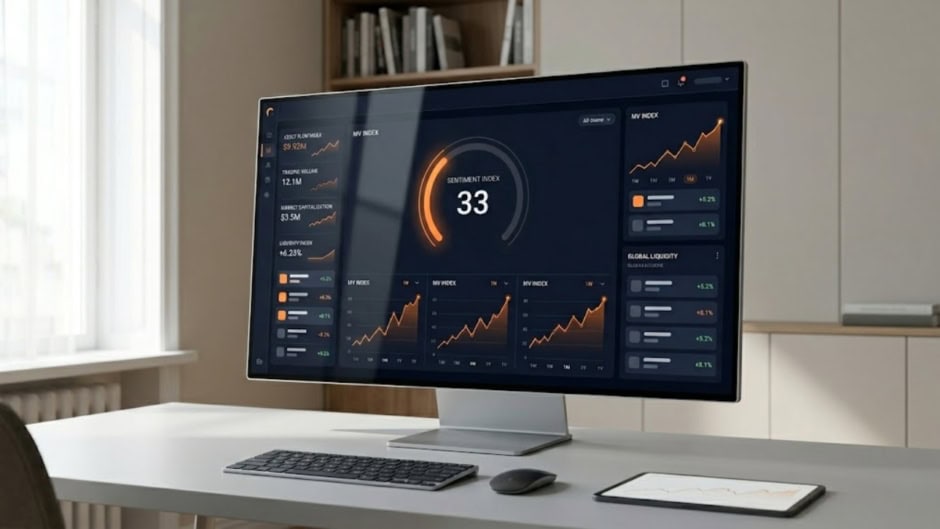
The cryptocurrency market remains firmly in a Bitcoin-driven phase, with the Altcoin Season Index holding at 33.

What’s Going On?
The index, tracked by CoinMarketCap, measures how the top 100 cryptocurrencies perform against Bitcoin over a rolling 90-day period, excluding stablecoins and asset-backed tokens. A score of 33 means only about one-third of major altcoins have managed to beat Bitcoin’s returns during this window.
Market benchmarks define an “altcoin season” when at least 75% of top tokens outperform Bitcoin. Current levels remain far below that threshold, confirming capital continues to concentrate in Bitcoin rather than spreading across the broader market.
Analysts link the trend to cautious investor behavior. During uncertain market conditions, funds tend to move toward assets seen as more stable and liquid. In crypto, Bitcoin plays that role, similar to large-cap stocks in traditional markets. Bitcoin dominance has risen to around 59.7%, with a pattern of higher lows since 2022, showing the flagship asset keeps absorbing the majority of inflows.
The Altcoin Speculation Index from Capriole Investments sits at around 21%, and only 11% of altcoins trade above their 50-day moving averages. These readings point to widespread weakness across the altcoin market, not isolated to a few projects.
What Structural Changes Can Investors Expect?
The current phase also reflects structural changes in how capital enters the crypto market. Institutional flows, including interest in Bitcoin-focused investment products like spot ETFs, have directed new money toward BTC instead of altcoins. These products have funneled billions from traditional finance directly into Bitcoin, bypassing the altcoin market entirely.
At the same time, regulatory pressure on token classification and higher funding rates for leveraged altcoin positions have reduced speculative activity. The result is a market where both retail and institutional investors are choosing the relative safety of Bitcoin over higher-risk alternatives.
Within the altcoin market, performance remains uneven. While most tokens continue to track Bitcoin’s movement rather than outperform it, some sectors have shown resilience. Real-world asset (RWA) tokenization and decentralized physical infrastructure networks (DePIN) have attracted selective interest. This suggests informed capital is making targeted, thematic bets rather than participating in a broad altcoin rotation.
Historically Speaking
Historically, low index readings have appeared before broader altcoin rallies. Similar patterns emerged before the 2017 and 2021 market cycles, when prolonged Bitcoin dominance later gave way to rapid gains across alternative tokens. Those periods represented accumulation phases for altcoins.
A transition typically needs a catalyst, either a stabilization in Bitcoin’s price or a surge of new capital entering the sector and seeking higher-risk, higher-reward exposure. The U.S. Federal Reserve resumed liquidity injections in late 2025, adding roughly $40 billion per month, which has supported risk assets broadly. Bitcoin dropped from its October 2025 all-time high near $126,000 to roughly $69,000, resetting leverage across the system. Many altcoins now sit at long-term structural support zones, limiting the downside relative to previous cycles.
For investors, the index reading of 33 points to a continued overweight position in Bitcoin over altcoins. But history also shows these phases do not last forever. A sustained drop in Bitcoin dominance below 50% and a climb in the index toward 75 will signal the rotation is underway.