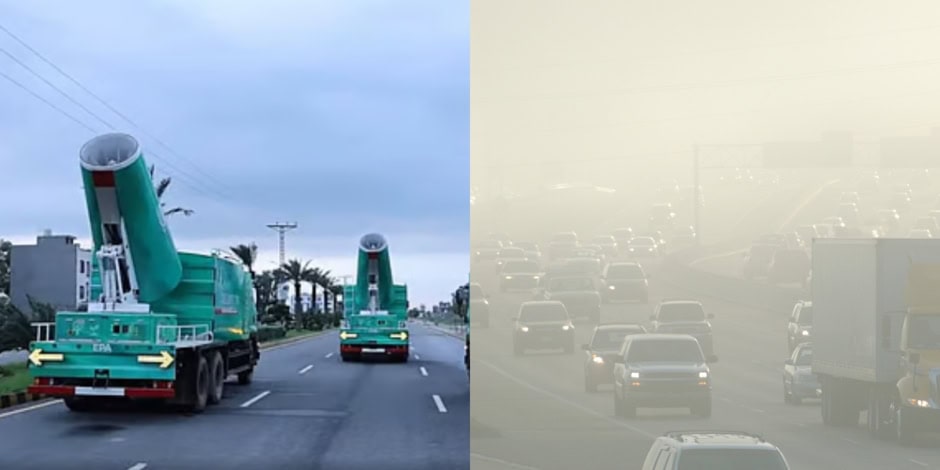
Lahore’s fight against smog may come at a high price; its already depleting water resources. The Punjab government’s new anti-smog guns, designed to reduce air pollution, could worsen the city’s severe groundwater crisis, experts warn.
Punjab Launches Anti-Smog Operations
The Punjab government has activated anti-smog guns and launched night operations in high-pollution zones across Lahore. These water cannon vehicles spray a fine mist into the air to reduce dust and particulate matter.
In the first phase, 15 vehicles are being used on a trial basis. Each cannon can hold 12,000 litres of water and completes a spray cycle within an hour.
According to Sajid Bashir, spokesperson for the Punjab Environmental Protection Agency (EPA), the agency uses 16 air quality monitors across Lahore to identify areas where pollution levels rise. After fog cannons were used in the Kahna area, the concentration of PM10 particles in the air dropped by almost 70 per cent.
He added that the EPA has formed a technical committee. The committee will assess the impact of the water cannons by analysing air quality data from different regions. Bashir rejected claims that the project lacks a scientific basis. He stated that the research conducted in China was on a limited scale. Also, their climatic conditions were different from Lahore’s. He assured that the anti-smog guns used in Lahore are designed according to local weather conditions and wind speeds.
Experts Question Effectiveness of Anti-Smog Guns
Environmental specialists have criticised the project as a “smog theatre”, claiming it only offers an illusion of cleaner air. Maryam Shah, communications specialist at the Pakistan Air Quality Initiative, said that while these water cannons can bring short-term relief in certain areas, their scientific effectiveness was extremely limited. For instance, China had also experimented with this technology for a while but eventually abandoned it because it did not significantly reduce smog levels.
Similarly, Dr. Muhammad Yaseen, a water resources expert at the Centre for Integrated Mountain Research, University of Punjab, called the policy unsustainable. He warned that using water cannons is only a temporary fix since it consumes enormous amounts of water. Given that Lahore is already facing a severe water scarcity issue, the use of these cannons could make matters even worse.
According to Water and Sanitation Agency (WASA) data, Lahore’s groundwater table drops by two to three feet each year. It has fallen over 18 meters since the 1960s. In the 1980s, water was found at a depth of 15 meters. But now it lies below 70 meters in some areas.
Environmental lawyer Altamash Saeed highlighted that if a single water cannon runs for 12 hours daily, it uses 144,000 litres of water. With 15 cannons, total consumption exceeds 2.2 million litres per day. He added that guns only bring larger particles down temporarily. They have no impact on the finer and more hazardous PM2.5 particles. These particles are the most harmful to human health since they can enter the lungs and bloodstream, leading to heart and respiratory diseases.
Long-Term Solutions Needed
Hammad Naqi Khan, Director General of WWF Pakistan, stated that water scarcity poses a greater threat to Lahore than smog. He said that emissions from vehicles, poor-quality fuel, and unfiltered industrial discharge are the main causes of air pollution. Unless these are addressed, no “anti-smog” campaign can succeed. While smog cannons may provide temporary relief, sustainable improvement in air quality requires fundamental reforms.
Maryam Shah summed it up succinctly. She said that fog cannons offer temporary comfort. But if the government fails to address the root causes of pollution, water scarcity will kill Lahore before smog does.