
Bitcoin failed to hold the $70,000 level this week, even after one of the most positive stretches of institutional news the crypto industry has seen in months. The world’s largest cryptocurrency briefly surged toward $74,000, but by the end of the week it had fallen back below $69,000, wiping out roughly $110 billion in market value.
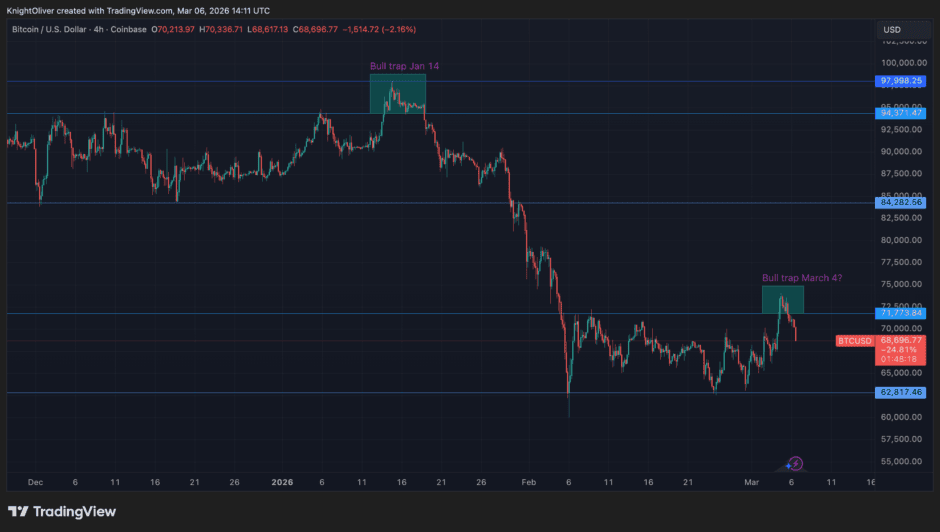
The pullback came despite a series of developments strengthening ties between crypto and traditional finance.
Several major announcements highlighted growing institutional adoption of digital assets.
Investment bank Morgan Stanley appointed as a custodian for its spot Bitcoin ETF exposure, expanding Wall Street infrastructure supporting the asset class.
Meanwhile, crypto exchange Kraken secured access to the U.S. Federal Reserve’s payment system a significant milestone integrating crypto firms with the traditional banking network.
In another major development, Intercontinental Exchange (ICE), the owner of the New York Stock Exchange, invested in crypto exchange OKX, valuing the company at around $25 billion.
U.S. President Donald Trump also publicly encouraged traditional banks to establish workable relationships with the crypto sector.
In earlier crypto cycles, such announcements might have triggered a sustained rally. This time, however, broader economic forces overshadowed the industry’s positive news.
The downturn was largely driven by macroeconomic developments. Tensions surrounding Iran escalated after President Trump said there would be “no deal with Iran,” raising fears of further geopolitical instability.
The situation pushed oil prices higher and strengthened the U.S. dollar, increasing concerns about inflation and the future path of interest rates. As the dollar index climbed, global risk assets including cryptocurrencies and tech stocks moved lower.
Bitcoin has become increasingly correlated with technology-heavy markets such as the Nasdaq Composite as institutional investors integrate crypto into broader portfolios.
Additional pressure came from growing cracks in the private credit sector. Asset management giant Black rock reportedly began limiting withdrawals from its $26 billion private credit fund amid rising redemption requests.
Similar stress emerged, which recently sold $1.4 billion in loans to meet investor withdrawals. These developments rattled broader financial markets and added to risk-off sentiment.
Market data indicates that short-term Bitcoin holders were among the biggest sellers during the decline.
According to analytics more than 27,000 BTC (about $1.8 billion) was moved to exchanges by short-term holders as the price approached $74,000. These investors often behave like traders, quickly locking in profits during volatile periods.
Analysts say the thin liquidity of the crypto market means such movements can have an outsized impact on price.
Despite the recent drop, there are signs of renewed institutional interest. A report from Research found that U.S. spot Bitcoin ETFs recorded about $787 million in net inflows last week, their first positive weekly flows since mid-January.
At the same time, funding rates across crypto derivatives markets have fallen to their lowest levels since 2023, suggesting that excessive leveraged positions have been flushed out conditions that historically create a healthier base for future rallies.
This week’s price action underscores a growing shift in the crypto market: macro forces now matter more than crypto-specific news.
As institutional adoption increases, Bitcoin is becoming more embedded in traditional financial markets. That means it increasingly reacts to the same drivers affecting equities, currencies, and commodities such as interest rates, liquidity conditions, and dollar strength.
While the short-term outlook remains uncertain amid geopolitical tensions and economic pressures, the expanding infrastructure around digital assets suggests the industry is continuing to mature beneath the surface.