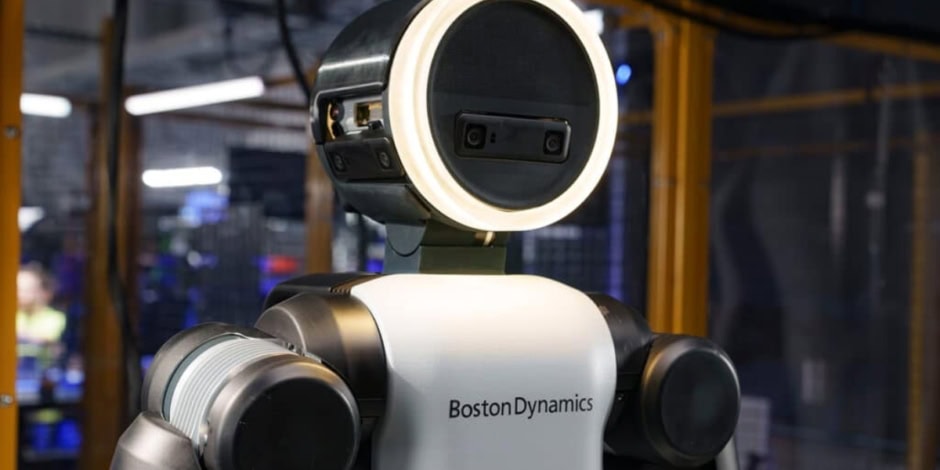
Boston Dynamics has transitioned its advanced Atlas humanoid robot from prototype to a market-ready product, unveiling production-focused specifications and industrial deployment plans after its presentation at CES 2026, the company confirmed.
Official statements from Boston Dynamics detail that the newest version of Atlas was engineered with consistency, dependability, and readiness for real-world environments in mind, marking a departure from earlier iterations that were largely focused on demonstrations and capability showcases. The production variant features robust operational capacity designed to work across a range of industrial settings, including warehouses and factories with structured tasks such as parts sequencing and material handling.
“For more than 30 years, Boston Dynamics has been building some of the world’s most advanced robots,” said Robert Playter, CEO of Boston Dynamics. “This is the best robot we have ever built. Atlas is going to revolutionize the way industry works, and it marks the first step toward a long-term goal we have dreamed about since we were children–useful robots that can walk into our homes and help make our lives safer, more productive, and more fulfilling.”
Boston Dynamics, majority-owned by Hyundai, has announced that it will deliver the first production units of Atlas to Hyundai and to its artificial intelligence collaborator, Google DeepMind. In both deployments, teams will integrate the robot’s capabilities with advanced AI systems to enhance perception, adaptability, and autonomous decision-making in real-world operations.
The market-ready Atlas features hardware that supports payloads of up to approximately 50 kilograms and operates reliably across challenging temperatures and environments to meet demanding industrial requirements. Engineers designed Atlas’s reach and mobility to handle a wide range of tasks, while allowing flexible supervision models ranging from full autonomy to remote operation through teleoperation or tablet-based control interfaces.
According to the official statement:
The robot can be controlled in three different ways: autonomous mode, teleoperated, or by using a tablet steering interface. Atlas has 56 degrees of freedom, fully rotational joints, a reach extending to 2.3M (7.5 ft), and the strength to lift up to 50 kg (110 lbs). The robot is also extremely water-resistant and can operate at diverse temperature ranges from -20° to 40° C (-4° to 104° F). Its safety features include human detection and fenceless guarding, and it can be integrated into workflows using barcode scanners or RFID.
Production plans include a phased rollout beginning in 2028 at Hyundai’s manufacturing facilities, with initial use cases focused on parts sequencing and material logistics. By 2030, project leaders anticipate expanding Atlas’s role to more complex assembly operations.
Boston Dynamics’ commercialization of Atlas underscores the growing emphasis on industrial robotics as a strategic tool to enhance operational efficiency and complement human labor in structured production environments. Stakeholders in manufacturing and logistics sectors will be watching how Atlas’s market entry influences broader adoption of humanoid robotics across global supply chains.