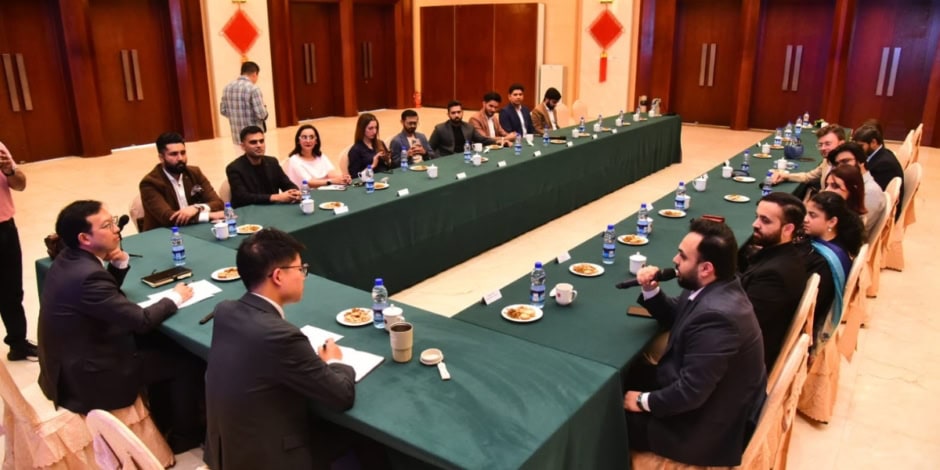
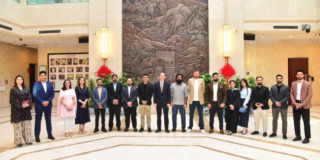
The Chinese Embassy in Islamabad hosted a special delegation of Pakistan’s leading digital media influencers and publishers, brought together by the Center for Regional Connectivity with Shared Future (CRCSF). The event aimed to further strengthen China-Pakistan relations through digital collaboration and enhance understanding of China’s development story among the Pakistani digital community.
The delegation included prominent figures such as Maarij Farooq and Moiz Farooq from Pakistan Economic Network, Laiba Farooq from Ittehad Digital Network, Kashaf e Murtaza from Pakistan TV, Talha Ahad, CEO of The Centrum Media, Talal Chaudhry, CEO of TechJuice, Influencer Hamza Bhatti, Social media Influencer Seemal Rehan, Imran Ghazali, former GM of the Digital Media Wing, Government of Pakistan, Hammad Ali Nasir, CEO of Adcelerate 360, Ammaar Bin Saleem, host of Outloud with Ammaar, Bakhtwar Raja, Palwash Abbasi, Mir Haris Ali, Ammar Alvi from the Digital Communications Department, Government of Pakistan, Ibrahim Afridi, Founder of Greenova8, and Waseem Ghaffar from the Digital Team of the Prime Minister’s Office.
The event began with welcome remarks by Mr. Shi Yuanqiang, Deputy Chief of Mission (DCM) of the Chinese Embassy in Pakistan, who warmly welcomed the delegation and described China and Pakistan as “ironclad brothers.” He emphasized that both nations can cooperate in the digital media sphere to spread positive narratives and counter misinformation. Mr. Shi highlighted that while the China-Pakistan relationship continues to strengthen, there is a need to further amplify its presence across digital platforms so that Pakistan’s young generation fully understands and values this friendship.
Mr. Shi expressed that the Embassy was delighted to host such a vibrant delegation of digital media leaders and hoped that they would soon have more opportunities to visit China and witness the country’s remarkable progress firsthand.
Following the opening remarks, Chinese Embassy officials delivered a comprehensive briefing on China’s socioeconomic transformation, focusing particularly on developments in Xinjiang and China’s nationwide poverty alleviation drive, which has lifted more than 800 million people out of poverty over the past 45 years. They described this as one of humanity’s greatest success stories.
The Embassy officials also addressed the issue of Western propaganda that attempts to misrepresent China’s achievements. They encouraged Pakistani digital influencers, including Talha Ahad, Imran Ghazali, Hamza Bhatti, and others, to use their platforms to promote truth and positivity.
A significant part of the briefing centered on the China-Pakistan Economic Corridor (CPEC), which the officials described as a “joint child” of both nations. They strongly refuted rumors of CPEC being halted, emphasizing that its success depends on the continued commitment and cooperation of both China and Pakistan. The briefing further highlighted the emerging opportunities for youth and the digital sector under CPEC Phase II.
The participants, including Hammad Ali Nasir, Ammaar Bin Saleem, Bakhtwar Raja, Palwash Abbasi, Mir Haris Ali, Ammar Alvi, Ibrahim Afridi, Seemal Rehan, and Kashaf E Murtaza, expressed their appreciation for the event. They remarked that it provided valuable insights into China’s development model, its vision for cooperation with Pakistan, and the immense scope for collaboration in digital communication.
Hamza Bhatti, Talha Ahad, and Imran Ghazali shared positive feedback, noting that the event deepened their understanding of China’s economic progress and commitment to Pakistan. They thanked the Chinese Embassy and CRCSF for organizing such an insightful engagement and emphasized that similar initiatives would play a crucial role in fostering stronger people-to-people connections between both countries.