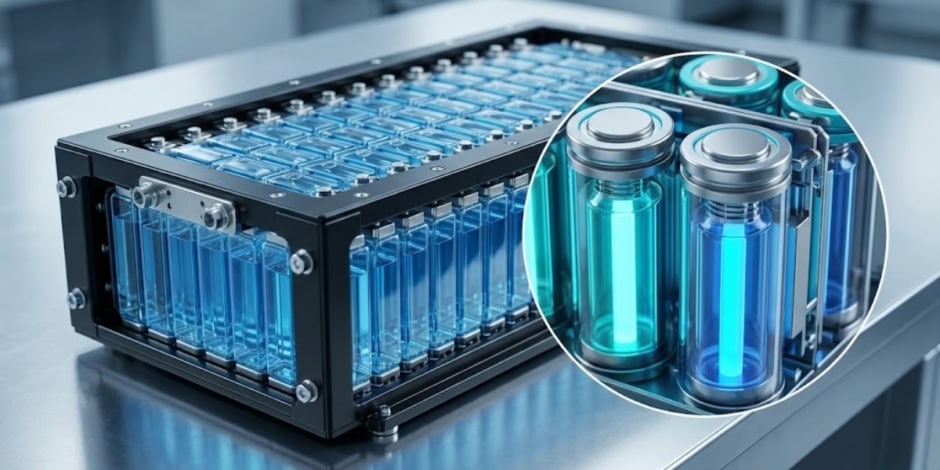
A research team led by Profs. Wang Song and Zhu Yongping from the Institute of Process Engineering of the Chinese Academy of Sciences have led a team of researchers that reported a major advance in thermal battery technology. The team unveiled a new cathode design that could significantly improve performance in extreme environments where conventional batteries fail.
A thermal battery is a type of thermally activated primary battery, primarily used in military applications such as power sources for weapon systems. Thermal batteries are a niche but critical energy technology, designed to operate at temperatures between 350 and 550 degrees Celsius. Unlike lithium-ion batteries, which degrade under heat, thermal batteries rely on molten salt electrolytes that only become conductive at high temperatures. This makes them essential for military systems, aerospace platforms, emergency power units, and deep-well drilling equipment, where instant energy delivery and reliability are non-negotiable.

Despite their resilience, thermal batteries have long faced a fundamental limitation: cathode instability. Transition metal fluorides, widely viewed as ideal cathode candidates due to their high theoretical voltage and thermal stability, tend to dissolve into the molten electrolyte during operation. This triggers the so-called “shuttle effect,” where active material migrates away from the cathode, leading to capacity loss, structural degradation, and shortened battery lifespan.
A research team led by Professor Wang Song and Zhu Yongping at the Institute of Process Engineering, Chinese Academy of Sciences, has now demonstrated a way to suppress this effect.
The researchers engineered a protective shell around cobalt fluoride cathode particles using a carbon coating derived from covalent organic frameworks. These frameworks, known for their crystalline and highly ordered porous structures, were converted into a carbon layer containing uniform sub-nanometer channels measuring about 0.54 nanometers in diameter.
This design allows beneficial ions to move efficiently during battery operation while blocking the pathways that enable cathode dissolution. By selectively confining the active material, the shell prevents the migration that causes the shuttle effect, preserving both capacity and structural integrity under high-temperature conditions.
According to Professor Wang:
Our findings provide a mechanistical foundation for designing next-generation high-energy-density thermal batteries through precise interfacial engineering.
The breakthrough research addresses one of the most persistent challenges in thermal battery development and moves the technology closer to broader, more reliable deployment. Their findings, published in Advanced Science on January 4, focus on precisely controlling the interface between the cathode and the molten electrolyte.
As demand grows for energy systems that can function in extreme environments, advances like this could play a key role in shaping the next generation of high-performance power sources.