The Defense Advanced Research Projects Agency (DARPA) awarded Morgan State University a $3.37 million contract to develop advanced radiovoltaic systems. These convert radioactive decay into electrical power. The program, called SYMPHONEE (Strontium-Yttrium Multi-junction PIN-based High-Density Output Nano-system for Extreme Environments), advances DARPA’s Rads to Watts initiative targeting compact, high-density energy sources lasting decades without refueling.
“Our team is pushing the boundaries of radiovoltaic technology, developing high-power, long-life systems that were not previously achievable,” said Project Technical Lead Professor Michael Spencer. “By integrating advanced materials, device engineering, and nuclear science, we are laying the foundation for a new generation of persistent power systems for extreme environments.”
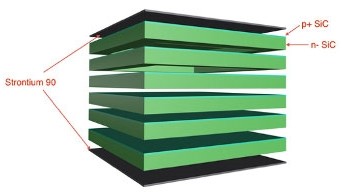
The system combines ultra-thin semiconductor layers with high-energy beta-emitting isotopes like Strontium-90, derived from recycled nuclear fuel or Cold War-era nuclear waste stockpiles. Project Omega, a research partner, describes the technology as directly converting radiation into electricity. This is very similar to how solar cells convert light. The proof-of-concept device aims to produce more than 10 watts per kilogram, supporting operations in extreme conditions where conventional batteries fail.
Strontium-90 offers significant advantages over traditional plutonium-based radioisotope systems used in spacecraft. It is substantially less hazardous and can be recycled from existing nuclear waste, addressing both energy density and waste management challenges simultaneously. The United States currently stores over 100,000 metric tons of nuclear waste at 52 reactor sites nationwide.
Morgan State coordinates the effort alongside Northrop Grumman, Pacific Northwest National Laboratory, Project Omega, Applied Research Associates, and Widetronix. Northrop Grumman contributes expertise in microelectronics, radiation effects, and advanced AI-driven modeling to accelerate design optimization. PNNL handles nuclear materials testing and characterization under demanding conditions.
According to the university:
This effort is focused on step-change improvements in power density, targeting systems capable of delivering meaningful electrical output from compact, long-lived sources. Early modeling indicates the potential to meet and exceed program targets for specific power and energy density, opening the door to entirely new mission capabilities.
A minimally viable prototype is expected by early 2027 following testing under increasingly realistic operating scenarios. Key technical challenges include improving energy conversion efficiency, validating long-term reliability over three decades, managing radiation effects on semiconductor performance, and ensuring safe deployment protocols.
If successful, the technology could provide reliable power for space missions, underwater infrastructure, remote sensors, autonomous systems, and military platforms operating in contested regions. Defense applications include persistent drones with multi-year operational lifespans, satellite systems requiring minimal maintenance, and forward-deployed equipment in remote or difficult-to-access environments. The Pentagon’s growing demand for unmanned systems and extended deployment capabilities has intensified interest in next-generation power solutions.