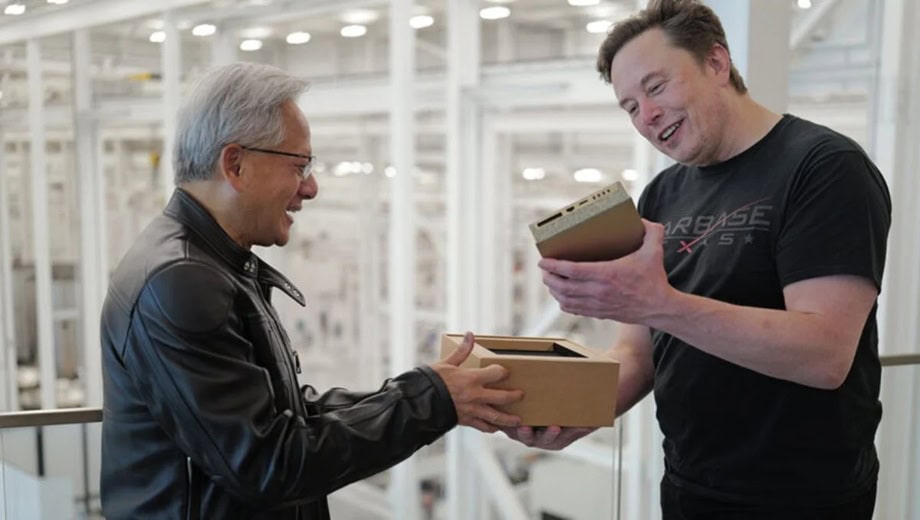
Tesla and SpaceX chief executive Elon Musk has weighed in on Nvidia’s newly unveiled Rubin artificial intelligence chips, praising their technical capabilities while cautioning that it will take time before the technology can be deployed at scale.
The Rubin platform, officially introduced by Nvidia at the Consumer Electronics Show (CES) 2026, represents the company’s next major step in AI computing, following its Blackwell architecture. Nvidia chief executive Jensen Huang described Rubin as a fully integrated AI computing platform rather than a single chip, combining GPUs, CPUs, networking hardware and data processing units into a tightly coordinated system.
Musk shared his view in response to a video posted by technology commentator Sawyer Merritt, which outlined the design and performance of the Rubin system. While acknowledging the engineering achievement, Musk said that large-scale deployment would not happen immediately.
“It will take another nine months before the technology becomes operational at scale and the software can function smoothly,” Musk wrote on X.
According to Nvidia, the Rubin platform is designed to deliver up to five times the performance of its current systems, with the Rubin GPU offering around 50 petaflops of inference performance using NVFP4 precision. The platform also introduces the Vera CPU to manage data movement and AI agent workloads, along with new interconnect and networking technologies such as NVLink 6, Spectrum-X, ConnectX-9 and BlueField-4, which aim to address bottlenecks in large-scale AI training and inference.
Jensen Huang also highlighted Nvidia’s new autonomous-driving AI system, dubbed Alpamayo, calling it a “ChatGPT moment” for self-driving technology. However, Musk expressed skepticism about how quickly such systems could be rolled out in the real world, saying that distribution and large-scale deployment remain “super hard” problems to solve.
Tesla’s head of AI, Ashok Elluswamy, echoed similar concerns about the challenges of scaling advanced AI systems beyond controlled environments, though Musk added that he wished Nvidia success in pushing the technology forward.
Nvidia’s chips have become a critical backbone for the global AI industry, powering data centers, research labs and a growing number of commercial applications. The Rubin platform is expected to play a central role in the next generation of large language models, robotics systems and autonomous vehicles.
Musk’s comments reflect a broader industry view that while AI hardware is advancing rapidly, turning breakthroughs into reliable, widely deployed products takes time. For now, Nvidia’s Rubin platform is being seen as a major technical milestone, one whose real-world impact will depend on how quickly companies can integrate it into practical systems.
As competition intensifies in the AI hardware space, the coming months will show whether Nvidia can convert Rubin’s promised performance into widespread adoption across industries ranging from cloud computing to transportation.