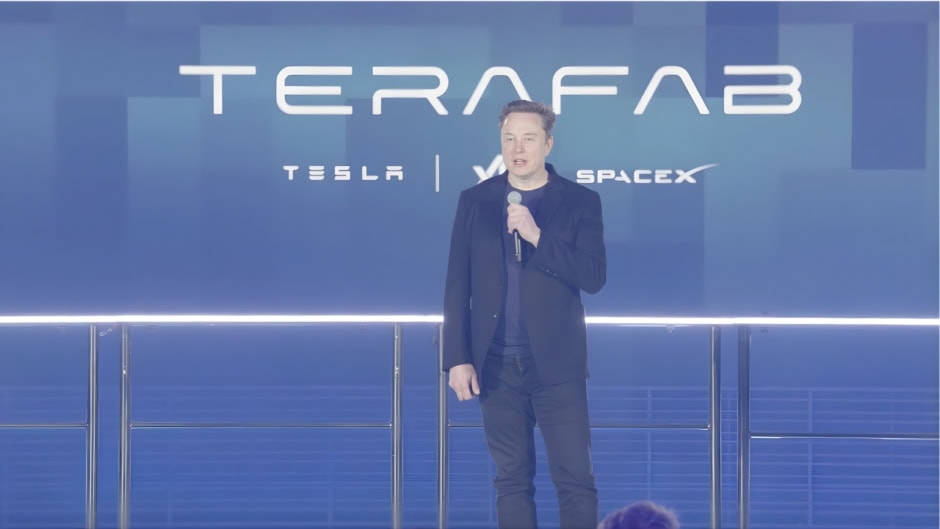
Elon Musk has announced Terafab, a semiconductor manufacturing initiative that brings together Tesla, SpaceX, and xAI under a single industrial vision: build the world’s largest chip factory, then use those chips to construct an AI computing network that extends from Earth into orbit and eventually to the lunar surface.
The project aims to produce up to one terawatt of compute capacity annually, a figure equivalent to one million megawatts. Terafab is designed as a vertically integrated facility that combines logic, memory, and advanced chip packaging under one roof, eliminating dependence on external semiconductor suppliers. The initiative directly targets the global shortage of high-performance chips needed for AI training, robotics, and large-scale infrastructure, a shortage that industry analysts expect to persist through the end of the decade.
Musk has outlined a dual-chip strategy. The first chip line will power Tesla’s Optimus humanoid robots and Tesla vehicles, supporting full autonomy. Musk has previously stated that Optimus production could eventually exceed car production by 10 to 100 times, which would create chip demand at a scale no existing foundry is built to satisfy.
The second chip, designated D3, is being developed specifically for space environments. It will drive AI data centres in low Earth orbit, powered by continuous solar energy. Musk argues that space-based AI computing could ultimately become cheaper than terrestrial alternatives because orbital solar panels receive uninterrupted sunlight, avoiding the intermittency and land constraints that limit ground-based renewable energy. SpaceX’s rapidly falling launch costs make the economics of deploying hardware into orbit increasingly viable.
The orbital computing concept centres on a distributed network of compact AI satellites, each generating approximately 100 kilowatts of power initially, with future versions expected to reach megawatt capacity. These systems would offload computing from Earth entirely, bypassing the land acquisition, cooling infrastructure, and power grid limitations that constrain terrestrial data centres.
The energy strategy behind Terafab is space-based solar power. Musk outlined plans to deploy massive orbital solar arrays capable of generating energy in space and beaming it back to Earth. This would require launching tens of millions of tons of equipment annually, an unprecedented logistical challenge that only SpaceX’s reusable rocket fleet could plausibly attempt.
Tesla’s Optimus robots are central to the plan beyond just chip demand. Musk envisions the humanoid robots operating and maintaining the orbital infrastructure itself, creating a feedback loop where the robots that the chips power also service the systems that produce and deploy those chips.
xAI, the AI startup that SpaceX acquired in February, provides the software and model development layer. The company was founded by Musk and has been building large language models and AI infrastructure. Integrating xAI into the Terafab ecosystem gives the initiative a vertically integrated stack from chip fabrication to AI model training to deployment in autonomous vehicles, robots, and orbital systems.
Looking further ahead, Musk proposed establishing an industrial base on the Moon to unlock petawatt-scale computing, roughly 1,000 times greater than the terawatt target. While acknowledging the speculative nature of the lunar ambitions, he framed them as a natural extension of a long-term vision for abundant energy and computing resources that are not constrained by Earth’s geography.
The announcement follows Musk’s August 2025 reveal of “Macrohard,” a tongue-in-cheek xAI project that aimed to simulate Microsoft as a fully AI-driven software firm. Terafab represents a far more concrete and capital-intensive commitment, one that positions Musk’s network of companies not just as consumers of advanced semiconductors but as manufacturers of them, competing directly with established chipmakers at a scale the industry has never seen.
Whether Terafab delivers on its ambitions or joins the long list of Musk announcements that exceeded their timelines, the initiative reflects a genuine strategic shift: the companies that control AI infrastructure in the coming decade may not be the ones that write the software, but the ones that fabricate the silicon and own the power supply.