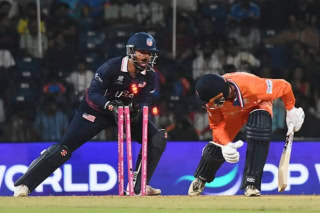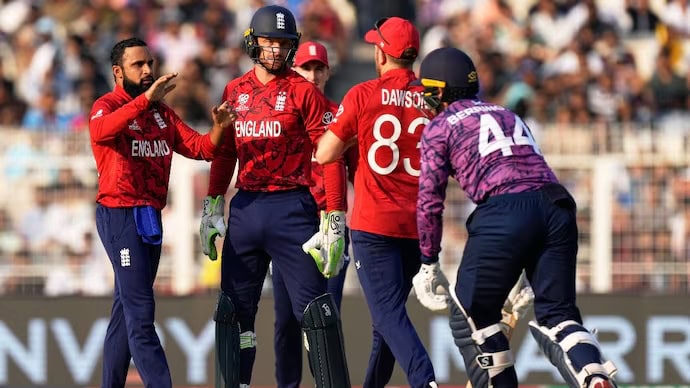
England posted 155 for 5 (Banton 63*, Bethell 32, Davidson 1-12) to edge past Scotland, who made 152 (Berrington 49, Rashid 3-36, Archer 2-24), winning by five wickets. It was another nail-biting encounter against an associate nation, but England’s hopes of reaching the Super Eight remain strong after this victory at Eden Gardens, moving them into second place in Group C with one match still to come.
Tom Banton’s unbeaten 63 off 41 balls, his fourth T20I fifty, proved decisive in a tricky chase of 153, which began poorly as openers Phil Salt and Jos Buttler fell within the opening two overs to disciplined seam bowling from Brandon McMullen and Brad Currie.
Banton then forged a crucial 66-run partnership with Jacob Bethell and followed it up with a 46-run stand alongside Sam Curran, bringing England within striking distance. After scoring just 4 runs from nine balls across innings against Nepal and the West Indies, Banton displayed his full range, hitting four boundaries and three sixes, while Will Jacks cleared the rope off Brad Wheal and pulled another behind square to wrap up the win with 10 deliveries to spare.
Scotland, much like Nepal in England’s first match, will rue their missed chances with the bat. They looked in command midway through the 13th over, with captain Richie Berrington putting together a 71-run partnership with Tom Bruce. Berrington’s aggressive strokeplay against spinners Adil Rashid and Liam Dawson helped compensate for a slow powerplay of 42 for 3 after losing the toss. Jofra Archer spearheaded the early assault for England, finishing with 2 for 24 and reaching the milestone of 50 T20I wickets.
Banton Steadies the Chase After Early Blows
England kept up the pressure when Dawson removed Bruce (24), and Rashid dismissed Berrington (49) within four balls. Scotland managed only four boundaries in the remaining overs, three of them from Oliver Davidson, who struck a huge six over cow corner off Archer on his way to a T20I career-best 20 not out.
Having left runs on the table, Scotland always faced an uphill battle. Despite some soft dismissals, like Harry Brook’s poor flick to short fine leg for 4, Banton’s commanding batting ensured England completed the first T20I clash between these historic rivals.
Tom Banton’s role at No. 4 in England’s batting order has sparked plenty of discussion. Traditionally an opener, he returned to the national side as a finisher, later sitting out for Ben Duckett before replacing the left-hander during the pre-World Cup tour of Sri Lanka. But after scoring 2 off 5 balls against Nepal and 2 off 4 against the West Indies, the Somerset batter was under the microscope, especially with many questioning whether Harry Brook had pushed himself too low at No. 5.
The pressure intensified when Banton walked to the crease at 13 for 2 at the end of the second over against Scotland. Early struggles continued, as he managed just 6 runs from his first 10 deliveries, half of them dot balls, against probing medium-pace seamers. Yet, leaning on Jacob Bethell in the initial phase of their partnership, Banton soon asserted himself, eventually contributing 36 of the 66-run stand.
Few English batsmen time the ball as cleanly down the ground, and left-arm spinner Mark Watt felt the full force of this. His first two deliveries were driven powerfully back over his head, followed by a third hit for a towering six over cow corner. These strokes settled both England and Banton, who finally looked at ease in the tournament.
A telling sign of his composure was that Banton did not play a single sweep in his 41-ball innings. While he enjoys both orthodox and reverse sweeps, he resisted, mindful of the six batters, Bethell and Brook among them, who had been dismissed attempting the shot, yet still found plenty of scoring options.
Archer’s Return and Scotland’s Late Collapse
Jofra Archer arrived in Kolkata still shaking off rust. Across his first eight overs in this World Cup, all in Mumbai, he had conceded 90 runs for just two wickets. His usual potency seemed muted, likely a consequence of returning too soon from the side injury that ruled him out of the last two Ashes Tests.
England has experience managing early comebacks for key players, but Archer’s return was a calculated risk: he remains their most incisive fast bowler. Eden Gardens highlighted just why that risk was warranted.
The two wickets he claimed in his second over, the third of the match, proved crucial. George Munsey, who had earlier made a devastating 84 against Italy, was rushed by a length delivery and edged it to Banton at midwicket. McMullen fell off the very next ball, hurried by pace and lacking control, ballooning a catch to Phil Salt at deep square leg. In his first three overs of the match, Archer gave away just 13 runs.
Up-tempo, strong through the crease, and even flashing a few smiles, particularly when Oliver Davidson managed to defend a fiery yorker in his final over, Archer’s return was encouraging on multiple fronts. It was clear he was back to enjoying his craft.
Another close call for one of the tournament’s heavyweights. For neutral observers, it has become a recurring frustration in the group stages. England has now faced two such scares. Their escape against Nepal was even tighter than this one in Kolkata, with the opponents needing 13 from the final nine balls. Scotland, meanwhile, will be left rueing a missed chance to make history, even if there was still time on the clock.
Berrington and Bruce had more than doubled Scotland’s powerplay total within the first four overs of their innings. The captain was particularly troublesome for Rashid, scoring 17 off just eight balls and signaling another challenging session for the experienced leg-spinner.
However, when Berrington was trapped lbw by Rashid on the eighth delivery, it triggered a collapse: seven wickets fell for only 39 runs across the next seven overs. From a promising 113 for 3 with 45 balls in hand, a target of 180 seemed well within reach. In the end, Scotland fell 28 runs short, a deficit that proved costly in a tense second innings where every run could have eased English nerves.