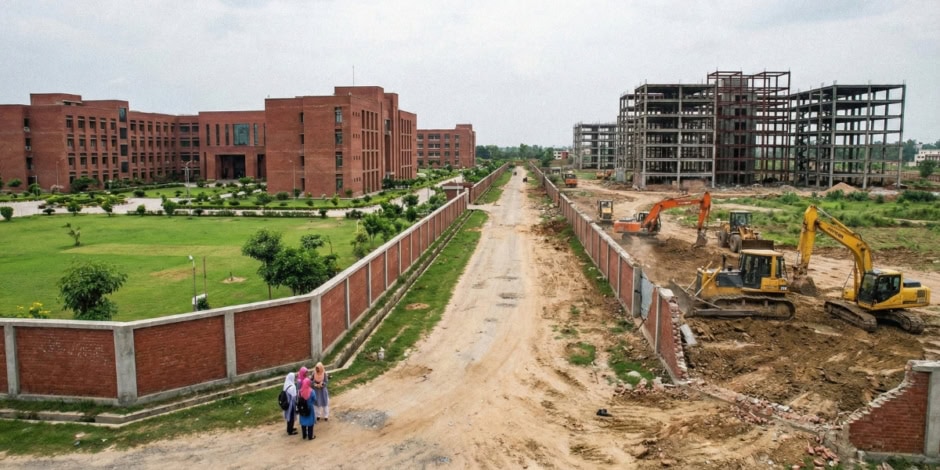
Prioritising bureaucracy over education is a dangerous game, but the government seems ready to play it. In a shocking move, the government has proposed seizing the majority of the land allocated to the Government College Women University (GCWU), Sialkot. Their goal? To construct a District Complex, courts, and Police Lines.
This controversy erupted after Defence Minister Khwaja Asif revealed the plan at a recent ceremony in Sialkot. He stated that the government intends to shift several District Complex offices to “Aimanabad Road”. To achieve this, they plan to take over 140 acres of the university’s total 200 acres.
Consequently, the university would be left with a mere fraction of its designated campus.
The “Cost-Saving” Excuse: A Legal Dead End?
The justification for this land grab is purely financial. Khwaja Asif, who hails from Sialkot, argued that the government cannot afford to purchase additional land. He explicitly described the move as a “cost-saving measure”.
According to the Minister, Aimanabad Road is set to become an administrative hub. However, this “hub” comes at the direct expense of women’s higher education.
Critics and civil society members immediately pushed back. They argue that this proposal is not just bad policy… it is likely illegal. Stakeholders are citing a specific Supreme Court ruling (Human Rights Case No. 974-P of 2009) to block the move.
On May 27, 2009, a three-member bench headed by then-Chief Justice Iftikhar Muhammad Chaudhry ruled that land owned by an educational institution cannot be diverted for non-educational purposes. The court explicitly stated that such property is meant for education and future expansion. It cannot be handed over to other departments.
Previously, this same ruling stopped the construction of a Rescue 1122 centre on college land in Jhelum. Educationists argue that this legal principle directly applies to the GCWU situation.
Wasted Investment & Future Risks
The consequences of this decision would be severe. The Higher Education Department (HED) of Punjab originally acquired this site in 2013, specifically for the Imam Bibi Campus. Since then, the government has already spent approximately Rs. 6 billion on academic development. The land is currently enclosed by a boundary wall and razor wire.
Furthermore, university officials state that pipeline projects for expansion are already in place. They anticipate major growth in enrollment and faculty over the next decade. In fact, supporters argue that even the full 200 acres might not suffice for future needs.
Retired Additional Inspector General of Police, Mian Muhammad Asif, penned a letter to the Sialkot DC urging protection for the land. He highlighted that GCWU Sialkot is the only public sector women’s university in the Gujranwala Division. Reducing its land destroys long-term educational planning for women.
Official Pushback: GCWU Sialkot Favoured For Now
The Federation of Universities Pakistan Academic Staff Association (FUPASA), Punjab chapter, condemned the proposal. FUPASA President Dr Muhammad Islam termed it an attempt to “illegally occupy” university land. He warned that teachers’ bodies would launch a protest movement if these assets are not safeguarded.
Currently, Punjab Higher Education Department Secretary Ghulam Fareed confirmed that the proposal was discussed. However, he noted that no final decision has been made yet. He admitted that violating the Supreme Court directions regarding educational land would be difficult.
Critics also point out the absurdity of the move. They argue that the existing “Kutchery Complex” is fully functional with recently constructed buildings. Therefore, shifting these offices is unnecessary.
As of now, no formal notification regarding the transfer has been issued. But the threat to Sialkot’s educational future remains real.