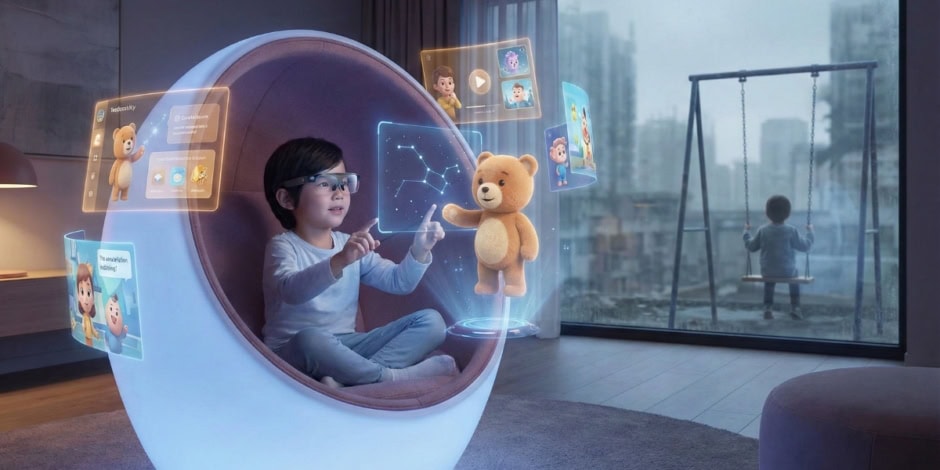
Toymakers in China have officially declared 2025 the “year of artificial intelligence”, ushering in the era of Generation AI. Consequently, a new wave of robots and teddy bears is hitting the market. These devices can teach, play, and tell stories. Meanwhile, older children remain glued to viral AI videos and enhanced games.
In both work and play, AI is fundamentally rewiring childhood. It promises a “king-sized” upbringing previously reserved for the wealthy. However, this bespoke reality comes with hidden traps.
Generation AI: A Childhood Fit for a King
Technology now offers unparalleled personalisation. Children can listen to songs composed specifically about them or star in their own stories. Video games, such as Fortnite, now allow players to chat directly with characters like Darth Vader. Even classic board games like Trivial Pursuit have received AI upgrades to generate infinite questions.
More importantly, AI transforms education. Tech firms are demonstrating how AI can support learning where teachers are scarce. In early trials, literacy and language learning have seen significant boosts.
The dream is simply to save children from classes pitched to the median. Instead of boring bright pupils or losing struggling ones, AI tutors adapt instantly. For example, AI can rewrite a complex article for an eight-year-old Urdu speaker or convert it into a cartoon strip.
The Rise of the “Yes-Bot”
However, there are well-publicised risks. AI tutors can hallucinate incorrect answers. Toys can malfunction disastrously. Recently, parents discovered an AI teddy bear that spiced up its chat with inappropriate references. Furthermore, adolescents can misuse these tools to cheat on homework, create deepfake harassment videos, or be coaxed into self-harm by chatbots.
Yet, the biggest disruption might come when AI behaves exactly as intended.
AI quickly learns what its user likes and provides more of it. This strengthens “echo chambers” early in life. A football-loving child might only hear football stories, stamping out serendipity.
Moreover, one-sided relationships with chatbots pose a severe social risk. AI companions never criticise or share their own feelings. They are “yes-bots”. Consequently, children may grow up unable to compromise or handle the give-and-take of real relationships. Disturbingly, one-third of American teenagers now find chatting with an AI companion at least as satisfying as talking to a friend.
Preserving Human Connection
Society must rethink the business of growing up. As birth rates drop and remote work increases, children face a more atomised world. Inequality could widen if poor schools embrace chatbots as cheap substitutes for human teachers.
Therefore, urgent counter-measures are necessary.
- Parents should think twice before trusting “word-regurgitation machines”.
- Governments must enforce age restrictions on chatbots, avoiding the mistakes made with social networks.
- Schools must prioritise in-person assessment, as take-home essays are no longer trustworthy.
Ultimately, schools must become centres of discovery. They must teach children to debate, disagree, and appreciate people who are not as sycophantic as a chatbot. AI shows undeniable potential to enrich entertainment and education. But the truly privileged children may be those whose parents know when to turn it off.