
Georgia Tech engineers have developed a breakthrough wireless system that lets sub-3-millimeter implants communicate directly through body tissue. The Smart Wireless Artificial Nervous System, or SWANS, represents a fundamental shift in bioelectronic medicine by eliminating the need for traditional antennas, Bluetooth, and surgical implantation procedures.
The system works by harnessing the body’s natural ionic conductivity to transmit electrical signals between implanted and wearable devices. When SWANS sends pulses through surrounding tissue, voltage gradients activate specific transistor switches programmed to recognize those signals. This approach delivers 15 times greater power efficiency than Bluetooth and 30 times better than near-field communication technologies. Researchers demonstrated the system in rats, connecting movement sensors on the front paw to neural stimulators in the hind leg.
Traditional wireless implantable devices face significant limitations that SWANS directly addresses. According to research from EPFL’s Neuro-X program, conventional approaches rely on bulky batteries that consume up to 90 percent of device volume, requiring complex surgical procedures for implantation. Wired connections meanwhile increase infection risk and restrict natural patient movement during recovery. The absence of truly miniaturizable wireless solutions has constrained both device design and clinical outcomes across neurology and cardiovascular applications.
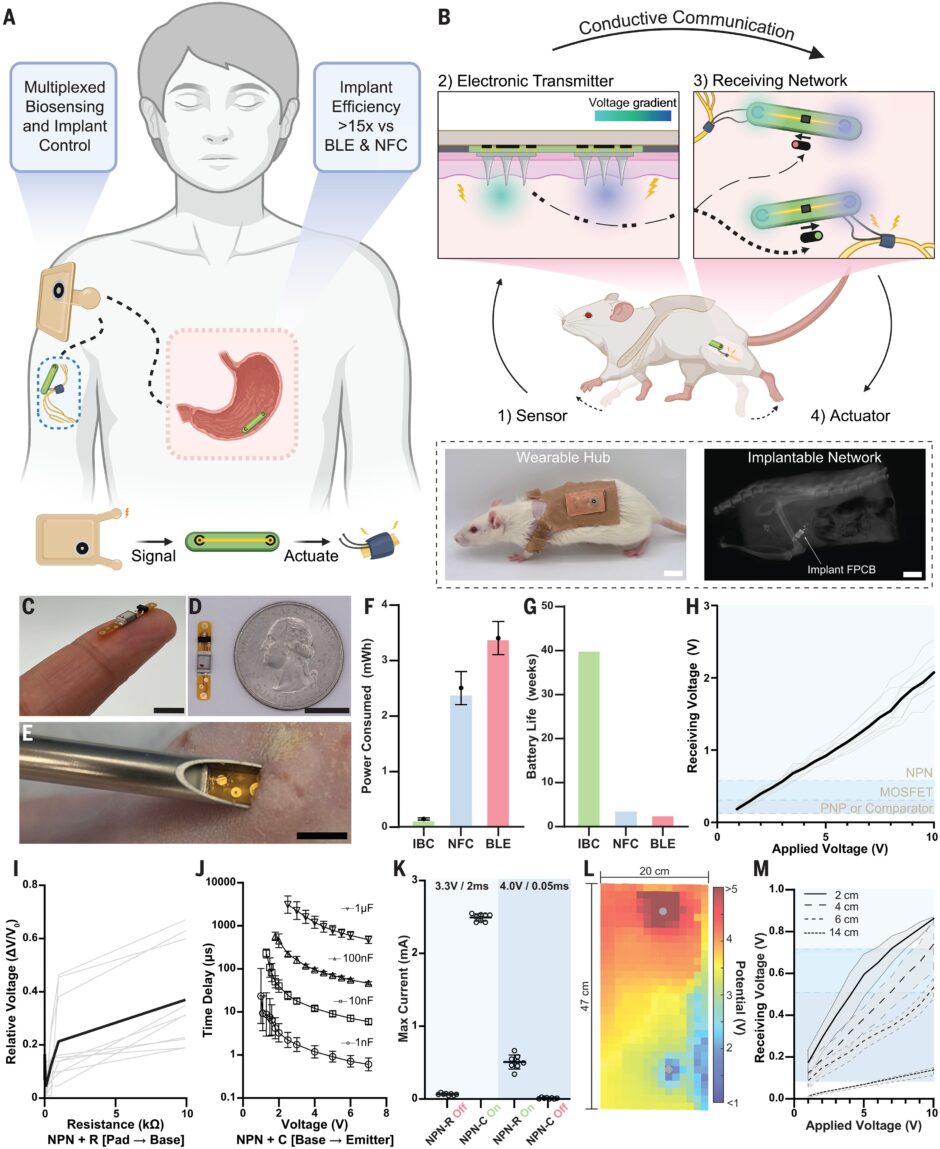
The miniaturization breakthrough enables syringe-based delivery instead of surgical incisions. Devices smaller than 3 millimeters can be injected through standard medical needles, dramatically reducing patient recovery time and infection risks. Each implant requires only passive electronic components that consume zero power while dormant, then activate when triggered to perform programmed actions. A small actuator activated once daily could operate approximately one year before requiring replacement.
Conformal soft electronic architectures represent another critical advancement demonstrated at the Materials Research Society Spring Meeting 2026. These designs match the mechanical properties of biological tissue to ensure stable operation across chronic timeframes without triggering immune responses. Researchers at the University of Arizona showcased how this tissue-compatible approach extends integration into bone through osseosurface electronics, enabling continuous monitoring of bone strain and fracture healing alongside neural and cardiovascular applications.
Senior author Alex Abramson stated the system’s transformative potential clearly: sensors and actuators no longer need alignment or proximity. They communicate seamlessly through surrounding tissue regardless of body location. This separation enables unprecedented clinical flexibility, allowing diagnostics in one region to trigger treatment elsewhere instantly.
“With our system, you can now place sensors in the best possible place to detect a biological signal and place actuators in the best possible place to perform a therapeutic action,” said Alex Abramson. “They don’t need to be connected, aligned, or even near each other; they can just send signals to each other through the surrounding tissue.”
The technology positions itself within rapidly expanding bioelectronic medicine markets currently undergoing major consolidation. Global implantable neural interface innovation has accelerated dramatically since 2020, with patent filings from Japan, South Korea, China, and Europe revealing convergence around four interconnected domains: electrode hardware, wireless power, closed-loop stimulation, and AI-driven signal processing. Next-generation brain-computer interface systems target over 10,000 channels with recording capability below 1 microgram noise levels, according to PatSnap’s 2026 neural interface patent landscape analysis.
The global bioelectronics market reached $10.1 billion in 2025 and is projected to reach $22.78 billion by 2032, growing at 12.31% annually. Applications include neural stimulation for Parkinson’s disease, epilepsy, and pain management, alongside continuous drug delivery systems that activate based on sensor feedback. Patent analysis shows no single assignee dominates implantable neural interfaces, indicating emerging technologies like SWANS could reshape competitive dynamics significantly.
Testing confirmed that electrical communication signals did not damage biological tissue samples, addressing safety concerns central to clinical translation. The external wearable hub can integrate readings from multiple implants simultaneously, enabling coordinated therapeutic responses across dispersed body locations. This distributed approach mirrors how the body’s own nervous system functions biologically, using ionic conduction for signal propagation.
“Our ultimate hope is to be able to fully automate human health — to be able to deliver a therapy exactly when it’s needed, where it’s needed, and to do so in a coordinated fashion across the body,” Abramson said.
Researchers emphasize this remains early-stage research requiring additional development before clinical deployment. However, the fundamental proof demonstrates closed-loop networks can monitor physiological conditions continuously and activate treatments automatically when needed. Industry observers predict SWANS-type technology could fundamentally reshape how implantable bioelectronics are designed, implanted, and networked across the next decade.
You can read the complete research paper here.