The federal government has moved to make battery manufacturing a key pillar of Pakistan’s energy security with the review of the National Lithium-Ion Battery Manufacturing Policy 2026–31. The policy aims to promote local production, attract global investment, and reduce reliance on imported energy storage solutions.

A high-level meeting chaired by Special Assistant to the Prime Minister on Industries and Production, Haroon Akhtar Khan, reviewed progress on the policy under the directives of Prime Minister Shehbaz Sharif. He said the battery policy will be fully integrated into Pakistan’s national energy security framework, with strong public-private partnerships playing a central role.
The policy includes phased localization, tariff reforms, and performance-based incentives to encourage domestic manufacturing. A dedicated working group was formed in December 2025 to fast-track implementation and coordinate with stakeholders.
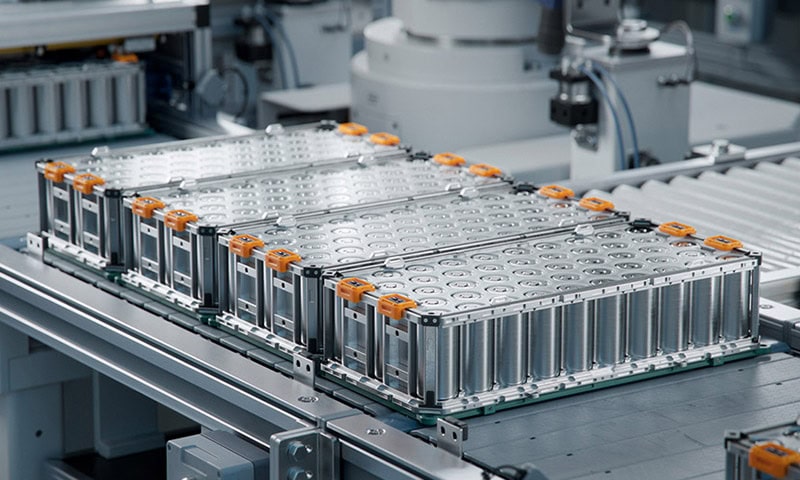
Officials highlighted that Pakistan has reserves of phosphate, iron, and manganese that can support local battery production and cut import costs. Lithium-iron-phosphate (LFP) battery technology has been approved for initial localization due to its safety and wide usage in solar systems, electric vehicles, backup power, and telecom infrastructure.
The government emphasized strict quality and safety standards, assigning a key role to the Pakistan Standards and Quality Control Authority. A framework for battery testing, certification, and recycling is also being developed to ensure environmental sustainability.
Under business-to-business cooperation with China, several multi-million-dollar agreements related to battery manufacturing have already been signed. Further coordination with federal and provincial mineral departments is expected as Pakistan works toward becoming a regional battery manufacturing hub.