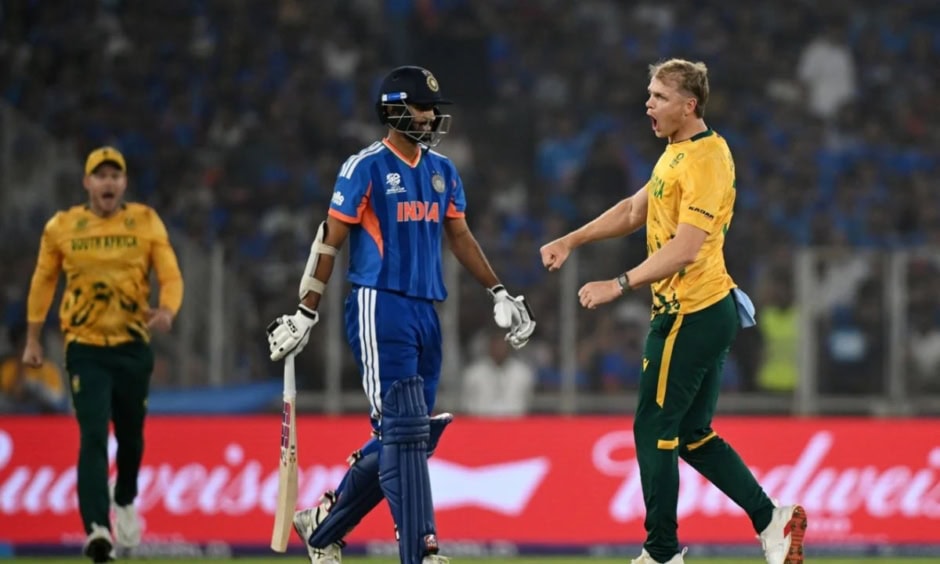
South Africa produced a dominant performance against India, halting their 12-match winning streak with a 76-run victory in a high-stakes T20 World Cup 2026 Super Eight encounter in Ahmedabad.
The home side struggled throughout their innings as South Africa’s disciplined bowling attack consistently applied pressure, reducing India to 86 for six after 14.1 overs with a mounting required run rate.
Hardik Pandya was dismissed attempting a six after the drinks break, caught at long-off by Tristan Stubbs off Keshav Maharaj, leaving India needing 102 runs from 33 balls for a daunting chase.
Shivam Dube and Pandya’s partnership managed just 30 runs off 23 balls, failing to accelerate the innings despite the steep asking rate, raising questions about India’s approach to net run rate preservation.
Miller and Brevis Rescue South Africa
South Africa’s middle order produced key contributions as David Miller and Dewald Brevis steadied the innings, scoring quickly while taking calculated risks, keeping India’s bowlers on the back foot throughout the contest.
Shivam Dube finally dismissed Brevis for 45 off 29 balls, but subsequent wickets fell quickly, including David Miller for 63 off 35, leaving South Africa well-placed at 152 for five in 15.4 overs.
Jasprit Bumrah returned brilliantly to restrict runs in the death overs, taking three wickets for just eight runs across two overs, highlighting India’s struggle despite individual brilliance in bowling execution.
India’s Batting Collapses Under Pressure
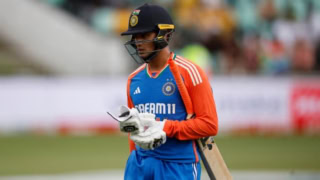
India’s top order faltered early as Ishan Kishan, Tilak Varma, and Abhishek Sharma failed to build momentum, leaving Suryakumar Yadav and Pandya with an almost impossible task against a high-quality bowling attack.
The sixth-wicket partnership collapsed under pressure, with wickets falling at a rapid rate, forcing India to chase at over three runs per ball, ultimately succumbing to a heavy defeat that jeopardizes semi-final prospects.
Tactical Decisions and Surface Conditions
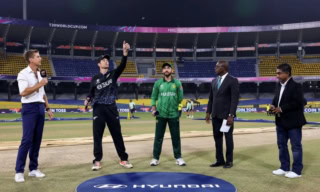
South Africa elected to bat on a black-soil surface that played slower than expected, while India omitted key spinner Axar Patel, indicating an intention to counter South Africa’s top order with offspin strategy.
Both teams adapted their line-ups based on familiarity with Ahmedabad, with South Africa leveraging previous matches on the surface while India struggled to execute their chase under mounting scoreboard pressure.