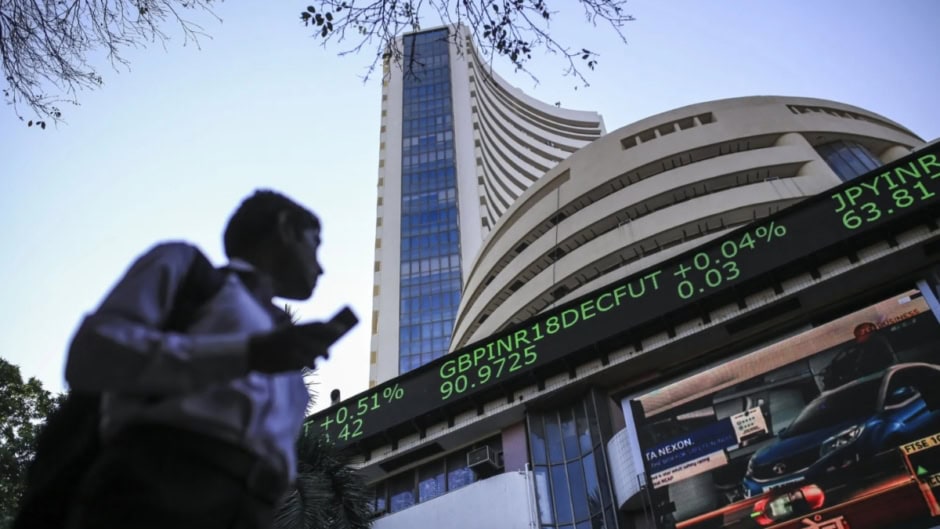
The Indian stock market crash deepened this week as escalating military tensions with Pakistan triggered heavy investor sell-offs, erasing an estimated $83 billion in market capitalization. Financial markets remained highly volatile following Pakistan’s retaliatory Operation Bunyan-un-Marsoos against Indian military strikes.

The Nifty 50 index dropped 1.1% on Friday, barely holding above the 24,000-point mark, while the BSE Sensex also slid 1.1%, falling below 80,000 points. This downturn ended a three-week rally for the two benchmarks, which recorded a weekly loss of about 1.3% — their worst performance in 2025 so far.
At the height of Friday’s trading volatility, total losses briefly soared to $108 billion before a slight late-session recovery.
Avinash Gorakshaka, head of research at Profitmart Securities, said, “With military escalation, domestic markets are jittery as fears of a prolonged conflict loom.” Analysts pointed out that the Indian stock market crash shifted focus from economic fundamentals to daily geopolitical updates.
India’s volatility index surged for the eighth consecutive session, hitting levels not seen in over a month. Twelve out of thirteen major sectoral indices ended the week in negative territory, with small-cap stocks suffering a 1.9% dip and mid-caps losing 0.8%.
The Indian rupee also came under heavy pressure, forcing the Reserve Bank of India to intervene to stabilize the currency markets.
Tata Motors Shines Amid Market Gloom
Despite the broader sell-off, Tata Motors stood out as a rare bright spot. Its shares jumped 8.7%, driven by optimism over a potential UK-US trade deal that could boost sales for its British arm, Jaguar Land Rover (JLR). Tata Motors ended the week as the top gainer among Nifty 50 constituents.
While the Indian stock market crash rattled investors, analysts remain cautiously optimistic that a potential US-India trade agreement and India’s economic resilience could mitigate long-term damage — provided diplomatic efforts succeed in de-escalating the conflict.
Simmering Tensions Between India and Pakistan
Hostilities between India and Pakistan flared after a deadly attack on April 22 in Pahalgam, Indian Illegally Occupied Jammu and Kashmir (IIOJK), which left 26 dead. India blamed Pakistan-based elements without offering proof, a claim firmly rejected by Islamabad.
Following the incident, India closed the Wagah border crossing, cancelled Pakistani visas, and suspended the Indus Waters Treaty on April 23 — moves that Pakistan labelled “acts of war.” In retaliation, Pakistan also sealed its side of the Wagah border.
Violence escalated further on May 6 and 7, as explosions hit Muzaffarabad, Kotli, Muridke, and Bahawalpur in Pakistan. Pakistan’s military confirmed Indian airstrikes and responded by launching Operation Bunyan-un-Marsoos.
Within an hour of launching the operation, Pakistan claimed to have shot down five Indian fighter jets, including four Rafales. Military spokesperson Lieutenant General Ahmed Sharif Chaudhry emphasized that Pakistan could have downed more but exercised restraint. The incident dealt a blow to India’s claims of air superiority, with CNN and a French intelligence source independently confirming the downing of at least one Rafale.
Moreover, Pakistan’s military reported intercepting 77 Israeli-made Harop drones allegedly deployed by India, using advanced electronic warfare systems. ISPR described this as a “panicked response” to Pakistan’s counterstrikes.
As part of Operation Bunyan-un-Marsoos, Pakistan targeted Indian military bases used to launch attacks on civilians and mosques. The operation also saw the deployment of Pakistan’s Al-Fatah missile, honoring the memory of children killed in recent attacks.