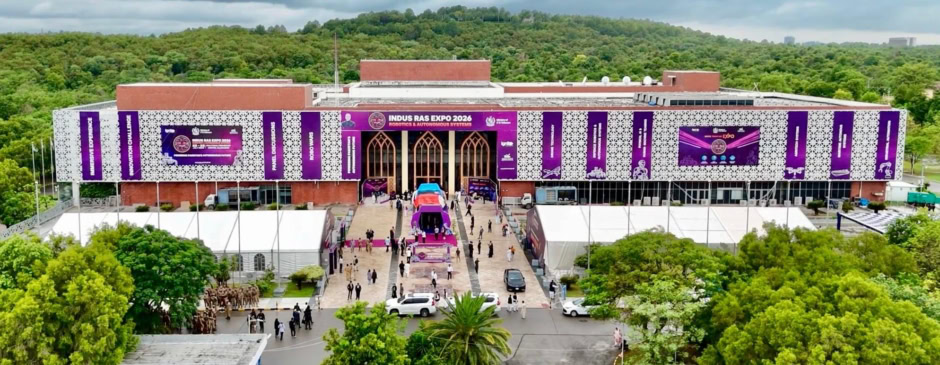
The Indus Robotics and Autonomous Systems Expo 2026 has concluded at the Pak China Friendship Centre in Islamabad after two days of exhibitions, live demonstrations, expert discussions, workshops and competitions. The event brought together government institutions, defence organizations, universities, technology companies, startups, researchers, investors, students and professionals. More than 25,000 registered visitors attended the Expo, making it a major public showcase for Pakistan’s growing robotics, artificial intelligence and autonomous systems ecosystem.
Organized by Ignite National Technology Fund under the Ministry of Information Technology and Telecommunication, the Expo was held in collaboration with the National Centre of Robotics and Automation and the NUST College of Electrical and Mechanical Engineering. The event aimed to connect research, industry and investment while giving local innovators a platform to present technologies developed in Pakistan.
Prime Minister of Pakistan Muhammad Shehbaz Sharif inaugurated the Expo as the Chief Guest, while Chief of Army Staff and Chief of Defence Forces Field Marshal Syed Asim Munir, NI (M), HJ, attended as the Guest of Honour. Federal Minister for Information Technology and Telecommunication Ms. Shaza Fatima Khawaja, members of the Federal Government, distinguished ambassadors, senior officials, academics, industry leaders and innovators also attended the opening ceremony.
During the inauguration, Prime Minister Muhammad Shehbaz Sharif announced the Pakistan Venture Fund with an initial commitment of USD 20 million. The fund is intended to encourage technology investment and support innovation-led enterprises. He also launched the SPARK and ELEVATE programmes, which aim to help researchers, startups and technology companies turn ideas and research into commercially viable products, competitive businesses and new employment opportunities.
The Expo featured 55 pavilions, including 13 startups and 42 leading organizations from the private and defence sectors. The exhibits covered a wide range of locally developed technologies, advanced prototypes and applied research, including defence robotics, drone technology, industrial automation, maritime autonomous systems, agritech, Physical AI and human-machine collaboration. Visitors also saw artificial intelligence-based decision support systems designed for practical applications.
Competition was another major part of the event, with a combined prize pool of PKR 5 million awarded to winning teams. RoboWars winners received PKR 2 million, while PKR 3 million was distributed among the winning teams of the RAS Innovation Challenge. These competitions gave students, researchers and innovators an opportunity to demonstrate their technical skills and develop practical solutions.
Speaking during the closing ceremony, Federal Minister for IT and Telecommunication Ms. Shaza Fatima Khawaja said the growing use of robotics and autonomous systems could play a major role in Pakistan’s economic and industrial development.
“Robotics and autonomous systems are becoming fundamental drivers of economic competitiveness, industrial modernization and national resilience. Indus RAS Expo 2026 reflects the Government of Pakistan’s and Prime Minister Muhammad Shehbaz Sharif’s commitment to investing in innovation, empowering local talent and creating opportunities for our researchers and entrepreneurs to develop technologies that can compete on the global stage.”
The Expo also attracted students, researchers, professionals, entrepreneurs and families, who took part in exhibitions, workshops, live demonstrations and interactive technology experiences. One of the most popular attractions was the Immersive Experience Dome, which offered a 360-degree digital journey showcasing emerging technologies and Pakistan’s vision for a digitally empowered future.
CEO Ignite Mr. Muhammad Bilal Abbasi, said the event demonstrated the importance of bringing government, academia, industry, and innovators together on a single national platform.
“The Expo showed the importance of bringing government, academia, industry, and innovators together on one national platform. He said the event strengthened connections, supported the commercialization of indigenous technologies, and gave innovators opportunities to present solutions that can contribute to Pakistan’s technological future.”
Beyond the exhibitions, the Expo created space for discussions around the challenges and opportunities facing Pakistan’s technology sector. The program included six panel discussions, three plenary sessions, and four practical workshops, along with several audience engagement activities. Topics included industrial adoption, research commercialization, startup growth, technical skills, infrastructure requirements, and the development of a national policy framework for robotics and autonomous systems.
The event was held as part of the broader Indus AI initiative and highlighted Pakistan’s efforts to build a connected ecosystem around artificial intelligence, robotics, and autonomous technologies. The partnerships formed, ideas shared, and technologies presented during the Expo are expected to support future research, commercialization, investment, and skills development while encouraging wider industrial adoption.