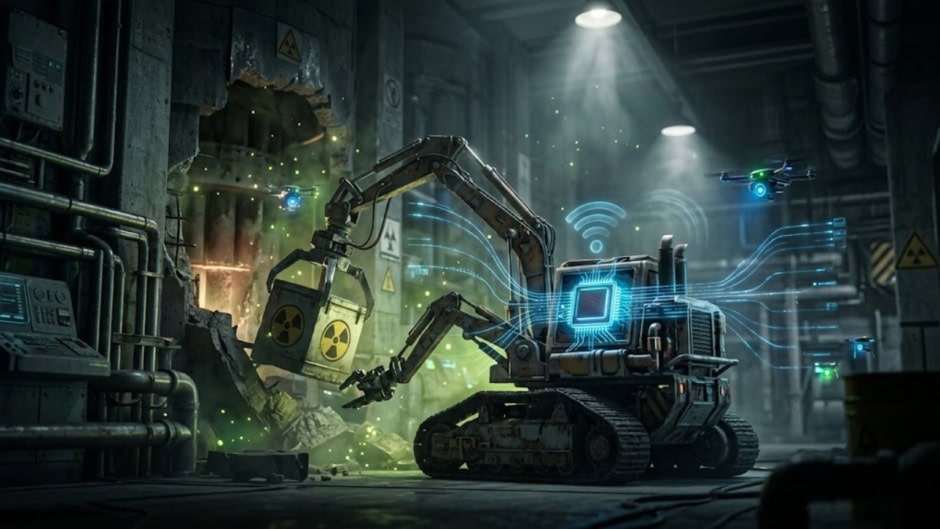
Fourteen years after the Fukushima Daiichi disaster, the most dangerous parts of the cleanup still depend on robots tethered to heavy LAN cables. The cables snag on jagged fuel debris, snap in confined spaces, and limit how many machines can operate simultaneously inside the damaged reactor buildings. It is one of the slowest, most physically constrained cleanup operations in engineering history.
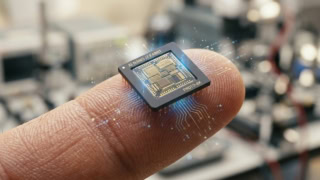
Researchers at the Institute of Science, Tokyo, have now developed a Wi-Fi receiver chip specifically designed to eliminate that bottleneck. The 2.4 GHz chip can withstand radiation doses of up to 500 kilograys (kGy), far exceeding what would destroy standard commercial electronics and well above the levels found even in the most contaminated areas of Fukushima Daiichi.
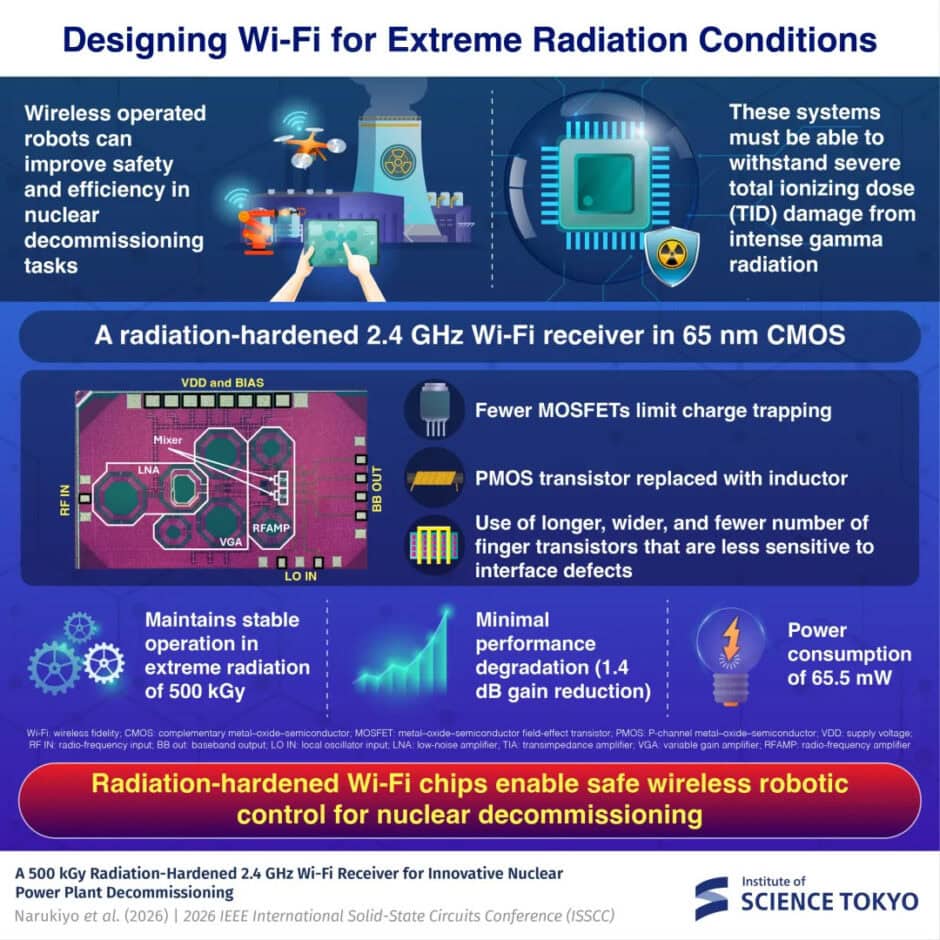
The core engineering challenge was straightforward but difficult: radiation kills silicon chips by trapping electrical charges in the insulating layers of transistors, causing uncontrolled leakage currents that drown out useful signals. The more transistors a chip has, the more surface area is exposed to this degradation.
The team’s solution was to radically simplify the chip’s architecture. They replaced radiation-sensitive active transistors in the variable-gain and radio-frequency amplifiers with inductors, passive components that remain stable under intense gamma bombardment. They then increased the physical dimensions of the remaining transistors while reducing the number of parallel segments, suppressing the “edge-related” leakage paths that radiation typically creates.
The result is a chip that maintains high-performance signal processing, including low-noise amplification and baseband conversion, while surviving conditions that would render standard electronics useless. In performance tests after exposure to 500 kGy, the chip showed only a 1.4 dB loss in gain. Noise levels and power consumption remained stable. Its communication performance stayed on par with standard commercial Wi-Fi receivers.
“By realizing Wi-Fi chips that operate stably even under ultra-high-dose radiation environments, wireless remote operation using robots and drones will be promoted, enabling reductions in worker radiation exposure risk and advances in work sophistication,” said Associate Professor Atsushi Shirane.
Wireless connectivity would allow multiple robots to operate simultaneously in hazardous areas without the cable management problems that currently slow every operation. It also opens the door to deploying drones inside reactor buildings, something that is effectively impossible with wired systems.
“Introducing such a wireless system eliminates the need for complex cabling and enables efficient and seamless operation of a large number of robots,” said Shirane.
The chip’s applications extend beyond nuclear decommissioning. Of the 423 nuclear power reactors currently in service worldwide, roughly half are projected to begin decommissioning by 2050, according to the International Atomic Energy Agency. Each of those projects will face similar challenges with remote robotic operations in high-radiation environments.
The chip’s radiation tolerance also exceeds the requirements for space-grade electronics, making it a candidate for deep-space exploration missions where radiation exposure is a persistent threat to onboard systems.
You can access the research paper here.