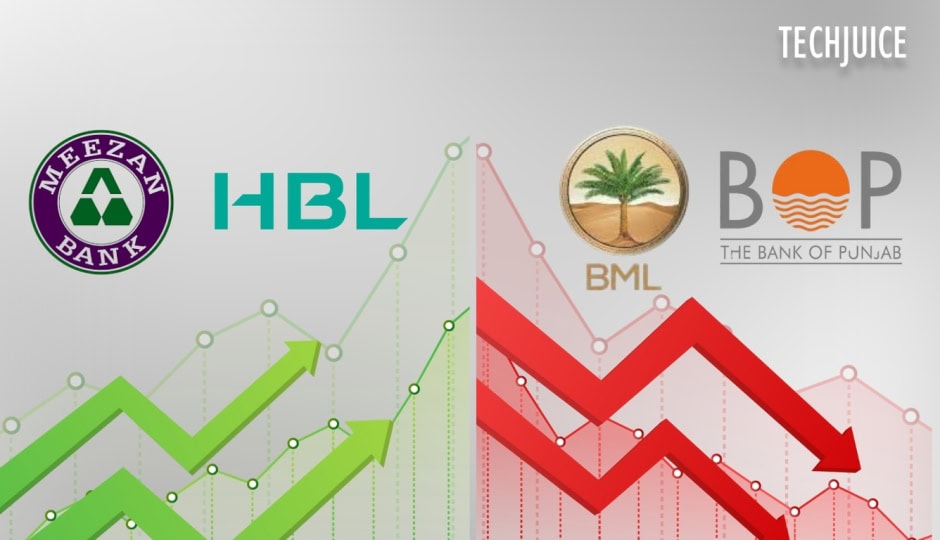
ISLAMABAD: Pakistan’s banking sector reported strong earnings for 2024, but newly released 4Q2024 financial data reveals a growing gap between leading banks and struggling institutions. While Meezan Bank (MEBL), United Bank (UBL), and Habib Bank (HBL) recorded substantial profits, Bank Makaramah (BML) and the Bank of Punjab (BOP) posted significant losses, raising concerns about systemic risks within the sector.
According to Topline Securities, Meezan Bank led the market with a net profit of Rs. 101.5 billion, followed by United Bank at Rs. 63.5 billion and MCB Bank at Rs. 57.8 billion. These banks benefited from strong net interest margins (NIM), cost management, and diversified revenue streams. In contrast, Bank Makramah reported a net loss of Rs. 5.2 billion, making it the worst performer of the year. While Bank of Punjab remained profitable with Rs. 5.3 billion in net profit, it faced a 17% YoY decline due to high provisioning costs, weak loan recovery, and increased operational expenses.
A senior analyst at Topline Research highlighted that while the sector’s overall profitability remains strong, the widening gap between top-performing banks and those facing challenges could indicate deeper issues. Some institutions are struggling with liquidity and asset quality concerns, which could pose risks to the financial system.
Several banks reported strong year-over-year (YoY) growth in net interest income (NII), with Meezan Bank seeing a 27% increase, Bank Al Habib 26%, and Bank Alfalah 22%. However, analysts caution that high NIMs alone may not ensure long-term stability, especially with rising interest rates increasing borrowing costs and default risks. In contrast, banks like Allied Bank and Standard Chartered experienced declines in net interest income, reflecting difficulties in asset growth and lending strategies.
The National Bank of Pakistan (NBP) declared a dividend of Rs8 per share for the first time since 2016, citing improved profitability. While this decision signals confidence in the bank’s capital strength, analysts warn that economic challenges such as inflation, currency risks, and market volatility could threaten the sustainability of these payouts.
With Pakistan’s economy facing uncertainty due to inflationary pressures and exchange rate volatility, the banking sector is under increased regulatory scrutiny. Analysts have raised concerns about weak loan portfolios, high provisioning requirements, and a heavy reliance on interest rate-driven income. Despite the sector trading at a 5.7x price-to-earnings (PE) ratio and 1.0x price-to-book (PB) ratio for 2025E, experts recommend caution due to the widening performance disparities among banks.
The 4Q2024 results expose underlying vulnerabilities in certain banks that could impact investor confidence. The financial struggles of Bank Makaramah and Bank of Punjab highlight potential systemic risks, even as stronger institutions like Meezan Bank, UBL, and HBL continue to strengthen their market positions. As 2025 progresses, the key challenge for Pakistan’s banking sector will be managing profitability while addressing risk factors to prevent financial distress from spreading to the broader economy.