Your Wi-Fi router sends data using radio waves. This new system sends data using light, and it is absurdly fast.
Researchers have built a chip-scale optical wireless transmitter that achieved an aggregate data rate of 362.7 gigabits per second over a free-space link spanning two meters. To put that in perspective, the fastest consumer Wi-Fi standard currently available tops out at around 46 gigabits per second under ideal theoretical conditions. This system delivered nearly eight times that speed, from a chip small enough to fit inside a device or ceiling-mounted access point, while consuming about 1.4 nanojoules per bit, roughly half what comparable Wi-Fi technologies require.
The results were published in the journal Advanced Photonics Nexus.
How It Works
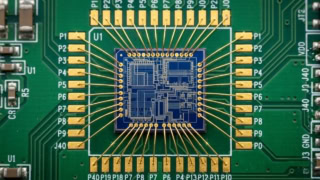
At the heart of the system is a 5-by-5 array of vertical-cavity surface-emitting lasers, known as VCSELs. These are tiny semiconductor lasers already widely used in data centers, facial recognition systems, and fiber optic communications. Each laser in the array sends its own independent data stream, and by running multiple lasers in parallel, the system multiplies its total throughput far beyond what a single light source could achieve.
In the experiment, 21 of the 25 lasers were active, each delivering between 13 and 19 gigabits per second individually. Combined, the output reached 362.7 gigabits per second. The system uses a modulation technique that splits data across multiple frequency channels, allowing it to use available bandwidth efficiently and adapt to signal conditions. The researchers noted that speeds could climb even higher with faster receivers on the other end.
Keeping the Beams From Stepping on Each Other
Running 21 separate laser beams in close proximity creates an obvious problem: if the signals overlap, they interfere with each other and the data gets corrupted. The researchers solved this with an optical system that shapes and directs each beam into its own defined area.
A microlens array first aligns the light from each individual laser, and additional optics then distribute the beams into a structured grid pattern. Testing showed that the system achieved more than 90 percent uniformity in illumination across the target area at a distance of two meters. That precision makes it possible to assign different beams to different users in the same room, effectively creating multiple independent high-speed wireless links from a single chip.
The team demonstrated this multiuser capability directly. In one test with four simultaneous links running at the same time, the system maintained stable connections and delivered a combined data rate of about 22 gigabits per second across those four users.
Why Light Instead of Radio
The fundamental advantage of optical wireless communication is bandwidth. Radio frequencies, which carry all of our current Wi-Fi, Bluetooth, and cellular traffic, are running into congestion problems. There is only so much spectrum available, and as the number of connected devices grows, video calls, streaming, cloud computing, and IoT sensors are all competing for the same limited airspace. Light operates at frequencies far above the radio spectrum, opening up vastly more bandwidth that is essentially untapped for wireless data transmission.
Optical signals also do not interfere with radio systems, which means a light-based network can operate alongside existing Wi-Fi without causing or experiencing interference. And because light can be directed precisely, it is naturally suited to dense indoor environments where many users need high-speed connections in a confined space, think offices, lecture halls, hospitals, and factories.
The energy efficiency is an added benefit that matters more than it might seem at first glance. As global data traffic continues to grow, the power consumed by wireless infrastructure adds up. A system that delivers dramatically higher speeds while using half the energy per bit could make a meaningful difference at scale.
What This Does Not Do
This is not a replacement for Wi-Fi. Light does not pass through walls, which means an optical wireless system requires line-of-sight or at least near-line-of-sight between the transmitter and receiver. It is designed to complement existing radio-based networks, not replace them, handling the heavy lifting of high-bandwidth data transfer in specific spaces while radio networks continue to provide broad coverage and mobility.
The technology is also still in the research phase. A two-meter link in a laboratory is a long way from a commercial product mounted in a ceiling tile. But the results demonstrate that the core physics and engineering work, and that chip-scale optical wireless systems can deliver speeds that radio-based technologies simply cannot match, at lower power, with hardware small enough to be practical.
For anyone wondering what comes after Wi-Fi eventually hits its ceiling, light is looking like a strong answer.