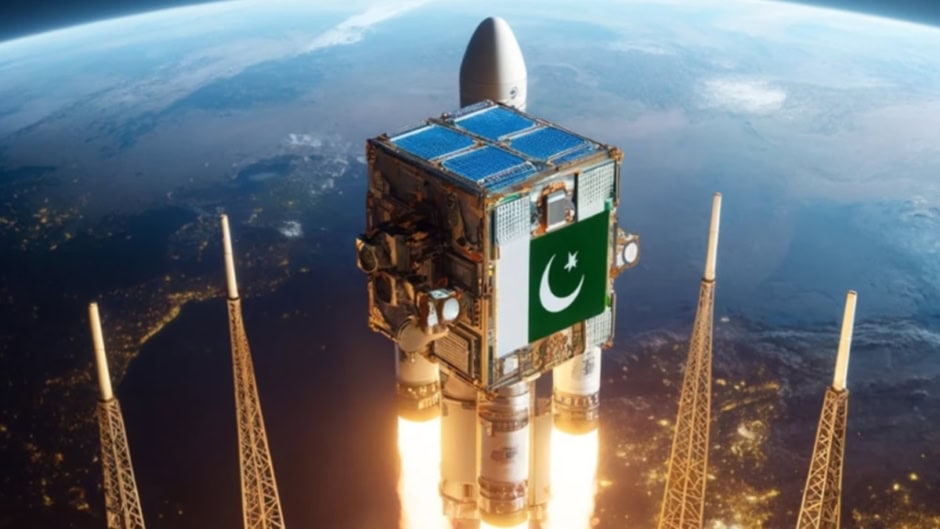
In a landmark announcement, Pakistan has set its sights on landing a spacecraft on the Moon by 2035, marking a bold new chapter in its space journey. The vision was unveiled by Federal Minister for Planning, Development and Special Initiatives, Ahsan Iqbal, during the launch of Pakistan’s fourth Earth Observation Satellite developed in collaboration with China.
The successful satellite launch not only extends the country’s capabilities in imaging and remote sensing but also symbolizes the next step in Pakistan’s long-term space ambitions.
Speaking at the launch event, Minister Ahsan Iqbal described the occasion as a historic leap for Pakistan’s technological progress. “This is more than just a satellite launch; it’s a step towards our destiny to be a leader in space science,” he said. “With a goal of landing a Pakistani spacecraft on the Moon by 2035, we aim to inspire our youth, attract global talent, and elevate our role in the global space economy.”
A Decades-Long Space Legacy
Pakistan’s space program dates back to 1961 with the formation of SUPARCO, making it one of the first developing countries to recognize the potential of space technology. From the launch of Badr-1 in 1990 to PakTES-1A in 2018, and PAKSAT-1R in 2011 to Paksat-MM1 in 2024, the nation has steadily expanded its capabilities. The recent Electro-Optical Satellite (EO-1) launch further strengthened Pakistan’s position in the Earth observation domain.
The newly launched satellite is expected to support disaster management, urban planning, food security, and climate monitoring through advanced remote sensing and GIS systems.
Pakistan’s ambitions for a moon landing are closely tied to its strategic partnership with China. Ahsan Iqbal praised China’s continued support in defence, infrastructure, and space cooperation under the China-Pakistan Economic Corridor (CPEC). He also acknowledged key Chinese partners, including BOMETEC, CETC International, and MicroSAT, for their role in executing the satellite project with speed and precision.
“This project is a testament to the evolving CPEC partnership; from roads and energy to technological excellence in space,” he noted.
Preparing for the Future of Space
The Minister emphasized Pakistan’s growing engagement with global space players such as China’s CNSA, Russia’s Roscosmos, APSCO, and ISNET. With the global space economy expected to surpass $1 trillion by 2040, Pakistan aims to:
- Expand its satellite constellation for comprehensive Earth observation
- Invest in space research and STEM education
- Launch joint space missions with China
- Achieve a successful moon landing by 2035
- Build a strong space industry ecosystem contributing to national growth
Thursday’s satellite launch not only advances Pakistan’s technological capabilities but also reinforces its commitment to long-term space exploration goals, with the 2035 Moon mission serving as a bold step toward positioning the country as a key player in the global space economy.