
Pakistan loses billions in legitimate tax revenue. Consequently, a new National Assembly motion targets the booming branded retail clothing sector. Currently, inadequate documentation and weak sales reporting plague the industry. You see it in every mall, every high street, every major city, and online as well. Therefore, highly profitable businesses operate in a severe “documentation vacuum”. Meanwhile, the country survives on borrowed money. This unfair system directly burdens ordinary citizens and small businesses.

The proposed legislative plan focuses on broadening the tax base for the branded retail clothing sector in Pakistan. It strictly avoids increasing current tax rates. Amnah Umair recently raised this motion in parliament. She clarified that the government does not intend to punish the industry. Rather, the primary focus remains on fairness, transparency, and accountability. Currently, middle-class families and small shopkeepers face relentless pressure for tax collection. By bringing major retail players into the net, the individual tax burden decreases for everyone. Thus, struggling salaried classes and small-scale traders will finally get the necessary relief.
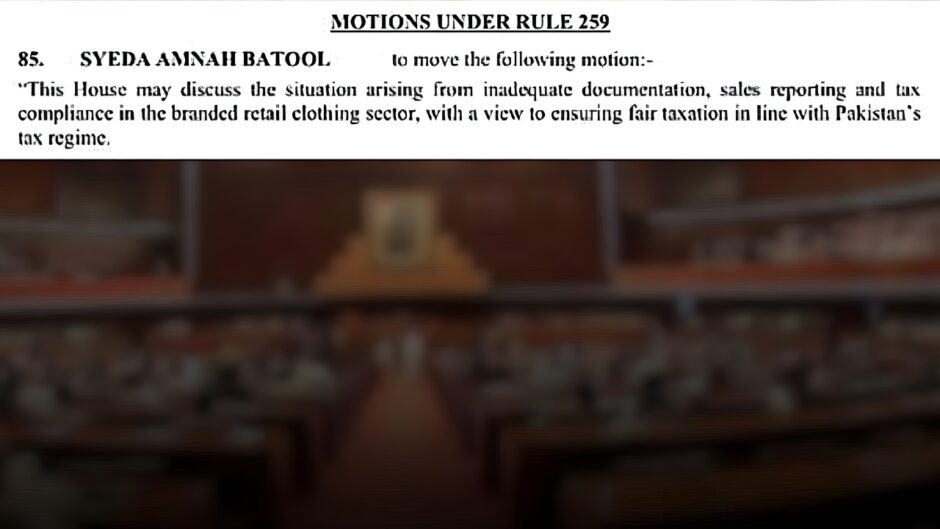
Furthermore, the motion demands a massive shift in tax enforcement. It specifically calls for ending the archaic “raid culture”. The state no longer needs physical tax inspectors standing at store doors. Instead, the strategy shifts entirely to data-driven auditing. Authorities will leverage better algorithms and track digital footprints to ensure strict compliance. Ultimately, this represents a smarter tax regime. It respects investors but demands absolute fiscal integrity. As of April 7, 2026, Pakistan must choose between an “economy of shadows” and an “economy of light” to build a responsible “Brand Pakistan”.