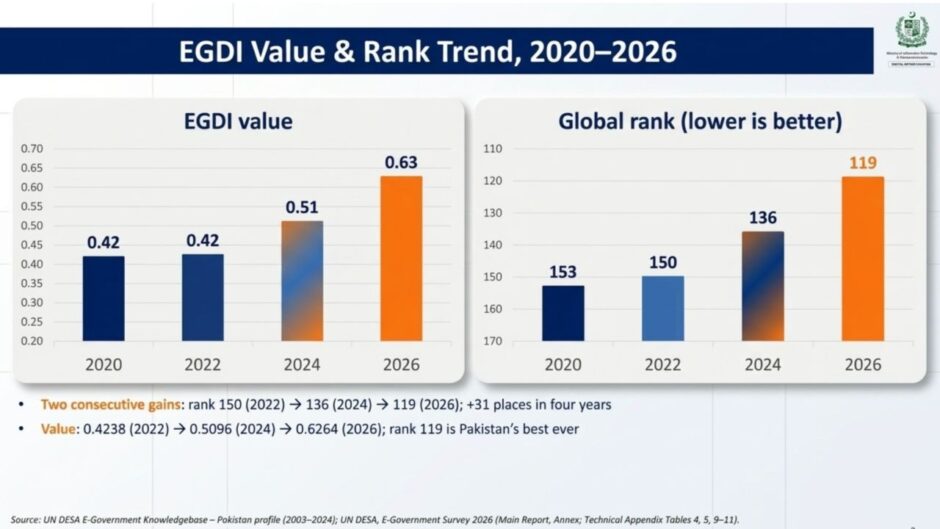
Pakistan climbed 17 ranks in the United Nations E-Government Development Index 2026, recording approximately 23% improvement in its overall EGDI score. The country’s IT minister announced the results on November 20, calling the jump “a milestone, not the finish line.”
The improvement builds on a steady upward trajectory. Pakistan ranked 150th in 2022, rose to 136th in 2024, and now sits at approximately 119th among 193 UN member states. The 2024 survey had already marked Pakistan’s first entry into the High EGDI category. The 2026 results push the country further up within that bracket.
All three component scores improved, though at vastly different rates. Online Government Services jumped 20%, from 0.7042 to 0.8422, pushing Pakistan into the Very High performance range on that pillar alone. Telecommunications Infrastructure recorded the largest gain at 39%, rising from 0.4745 to 0.6590. Human Capital, which measures literacy and schooling enrollment, improved by just 8%, from 0.3500 to 0.3778.
That disparity matters because each pillar carries equal weight in the final index. Pakistan’s digital rails have moved decisively ahead of its classrooms, and Human Capital now stands as the country’s weakest score by a wide margin. Closing that gap requires investment beyond the IT ministry’s scope, extending into federal and provincial education systems.
“The same report is honest with us, and we should be honest too. Human Capital, which measures literacy and schooling, is now our weakest pillar and it carries a third of the index. Our digital rails have moved ahead of our classrooms,” the IT Minister wrote on her LinkedIn.
The UN specifically cited the Digital Nation Pakistan Act 2025 as an important institutional reform in its assessment. The legislation established the Pakistan Digital Authority and the National Digital Commission, creating a centralized governance structure for digital interoperability, cybersecurity, and data standards across government agencies. IT Minister Shaza Fatima previously described 2025 as “the year of foundations” and 2026 as the year of scale.
The EGDI result follows other recent gains in international technology indexes. In July 2026, Pakistan jumped 27 places in the International Telecommunication Union’s ICT Development Index, with its score rising 20% from 56.4 to 67.7. The country also recorded a 22.8-point improvement in the connectivity pillar and achieved a Meaningful Connectivity score of 79.
On the skills front, the government announced over one million tech trainings and certifications this year. These programs include DigiSkills, ICT for Girls, semiconductor design courses, and AI training initiatives at national scale. Moreover, these programs target the Human Capital deficit directly, though their impact on literacy and schooling metrics will take years to register in the EGDI.
Within South Asia, Pakistan’s improvement stands out but context is important. India ranked 97th in the 2024 survey with an EGDI value of 0.6678. Bangladesh, Sri Lanka, and the Maldives all scored higher as well. Pakistan outperforms only Afghanistan in the region. The 17-rank jump narrows those gaps but does not close them.
The results arrive during a period of significant digital infrastructure expansion in Pakistan. Starlink is progressing toward commercial launch Even the GSMA published a comprehensive “Digital Pakistan 2030” roadmap in July.
However, the country continues to face internet throttling, VPN restrictions, and submarine cable vulnerabilities that undermine the connectivity gains these indexes capture.