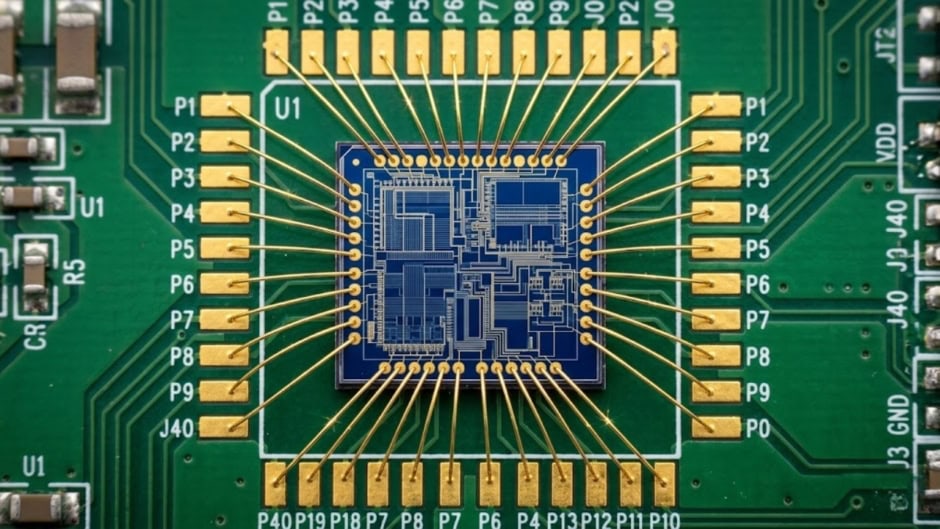
A team of researchers in China has demonstrated for the first time that a silicon-based quantum processor can perform a complete set of error-detecting logical operations, a milestone that had previously only been achieved on other platforms like superconducting circuits. The results, published in Nature Nanotechnology, mark a significant step toward building practical, fault-tolerant quantum computers using the same material that underpins virtually all modern electronics.
The team from the Shenzhen International Quantum Academy built a processor by placing phosphorus atoms into silicon with atomic precision, allowing individual control of each quantum bit. Using four physical qubits, they encoded two logical qubits capable of detecting errors during computation, an approach that allows the system to flag unwanted noise that could otherwise corrupt results.
Quantum systems are notoriously fragile. Environmental interference introduces errors that can derail calculations, making error correction one of the central challenges standing between today’s experimental devices and useful quantum machines. The standard approach is to encode information into logical qubits, which bundle multiple physical qubits together in a way that makes errors detectable and, eventually, correctable.
What makes this result notable is the completeness of what the researchers demonstrated. Rather than showing a single isolated capability, the team executed a full chain of operations: preparing error-checked quantum states, performing a universal set of logical gates (including single-qubit and two-qubit operations), and applying those operations in a real algorithm. The logical T gate, a particularly important and difficult operation for fault-tolerant computing, was achieved using a technique called gate-by-measurement.

To prove the system could handle a practical task, the researchers ran a quantum algorithm called the Variational Quantum Eigensolver to calculate the ground-state energy of a water molecule. The result closely matched the theoretical value, demonstrating that the processor can produce meaningful outputs rather than just passing abstract benchmarks.
The significance lies not just in the result itself but in the platform. Silicon is the foundation of the global semiconductor industry, meaning any quantum computing approach built on it could potentially leverage decades of existing manufacturing infrastructure. Superconducting qubits, the technology used by companies like Google and IBM, require exotic fabrication processes and operate under different physical principles. A viable silicon path to fault-tolerant quantum computing could ultimately prove more scalable and cost-effective.
The researchers said their work shows that the essential building blocks for fault-tolerant quantum computing are now achievable in silicon. That said, significant hurdles remain before silicon quantum processors can scale to the thousands or millions of qubits needed for commercially useful machines. Challenges include manufacturing qubits with consistent quality at scale, managing signal interference across large arrays, and integrating classical control electronics that can operate at the extreme cold temperatures quantum chips require.
Still, the result adds to a growing body of evidence that silicon is a serious contender in the quantum computing race. Earlier work from other groups had already demonstrated high-fidelity qubit operations and error detection in silicon, but this is the first time a complete logical framework has been shown to work on the platform, bringing it closer to parity with more established approaches.
You can read the full research paper here.