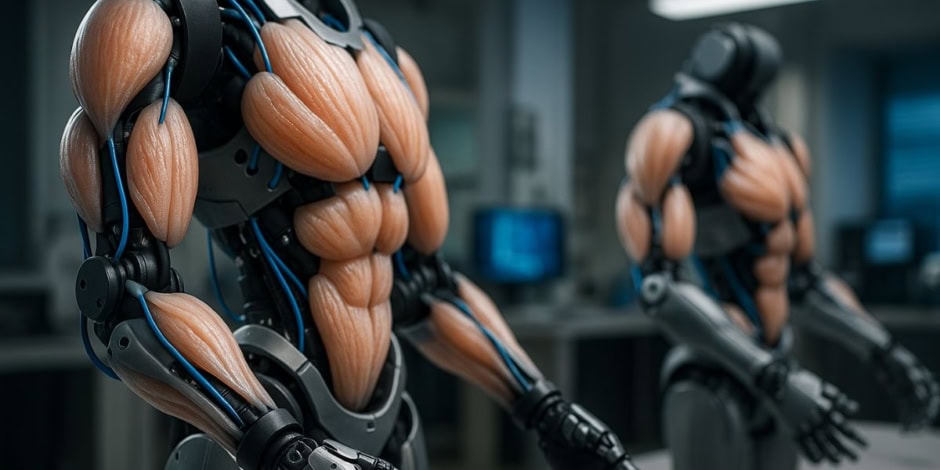
Researchers have unveiled a novel class of AI-enhanced artificial muscles built from bio-inspired, lifelike materials that mimic both the flexibility and strength of human tissue. The development marks a significant advance in soft robotics engineering.
Inside the Breakthrough: How the New Muscles Work
The new material system blends soft, flexible substrates with embedded sensors and actuators, enabling coordinated contraction, expansion and bending in response to AI-driven control signals.
“When people think of robots, they usually imagine something like The Terminator or RoboCop: big, rigid, and made of metal,” said Hong Yeo, the G.P. “Bud” Peterson and Valerie H. Peterson Professor in the George W. Woodruff School of Mechanical Engineering. “But what we’re developing is the opposite. These artificial muscles are soft, flexible, and responsive — more like human tissue than machine.”
The Technology Behind the Transformation
- Multimodal actuation: The muscles can contract and relax in complex patterns, controlled by AI models trained to replicate natural muscle behaviour.
- Embedded sensing: Integrated tactile and motion sensors provide real-time feedback, enabling closed-loop control and adaptability to changing loads and environments.
- Bio-mimetic materials: Using elastomer composites and fiber-reinforced gels, the structures deliver high strains and rapid responses while remaining lightweight and safe for human interaction.
Here’s Why AI-Powered Muscles Are Important
Traditional robotic actuators struggle with the trade-off between strength and flexibility: rigid motors offer power but lack compliance, while soft actuators offer flexibility but limited force.
These new AI-powered artificial muscles bridge that gap by delivering both. The result is a platform uniquely suited for dynamic, human-compatible applications such as wearable robots, prosthetics, assistive devices and agile robotics in unstructured environments.
Moreover, the coupling of AI lets the system learn and adapt to usage patterns, load changes and user intent, moving from pre-programmed motion to responsive, intuitive interaction.
Real-World Potential: From Labs to Living Systems
- Wearable robotics and exoskeletons: Devices using these muscles could conform to the body’s natural motions, provide assistance or rehabilitation while remaining comfortable and lightweight.
- Prosthetics: Artificial limbs could adopt muscle-like actuation and sensing to deliver smoother, more natural movement and feedback.
- Soft industrial robots: In manufacturing or service settings, robots with these muscles could handle delicate tasks or navigate confined spaces with greater agility and safety than rigid machines.
- Medical and biohybrid systems: Because the materials are lifelike and compliant, they could integrate with biological tissue or serve as soft implants, advancing the frontier of prosthetic integration and human-machine interfaces.
Obstacles on the Path to Adoption
Despite the breakthrough, several hurdles remain before widespread deployment. Scaling manufacturing of these advanced composites cost-effectively is a challenge. Robustness and durability under long-term cycling in real-world conditions must be validated. Integration with existing robotic control ecosystems and ensuring reliability in demanding environments are further concerns.
Additionally, while AI control adds adaptability, it requires data, context and safe fail-modes to ensure dependable performance in critical applications. Material fatigue, environmental robustness and calibration across users or tasks remain active research areas.
You can read the report findings here.