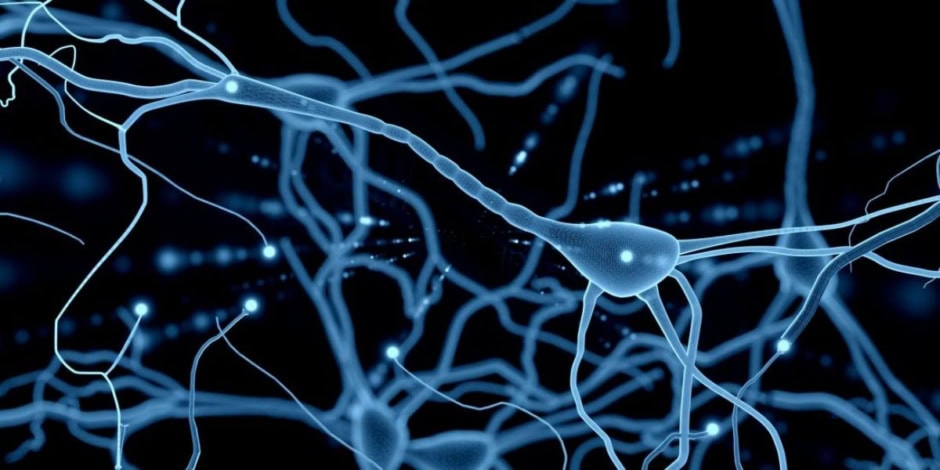
Researchers at the University of Southern California (USC) have engineered artificial neurons capable of replicating key electrochemical functions of biological neurons, marking a major advancement in the field of neuromorphic computing and AI hardware.
What Are Artificial Neurons?
Unlike conventional silicon processors and even existing neuromorphic chips, which simulate neural behaviour via software, the USC team’s devices physically embody biological processes using ion motion. Specifically, the artificial neurons are built with silver ions diffusing in an oxide layer to form electrical pulses, emulating how brains convert electrical signals into chemical ones and back again.
“Even though it’s not exactly the same ions in our artificial synapses and neurons, the physics governing the ion motion and the dynamics are very similar,” says Yang.
He adds, “Silver is easy to diffuse and gives us the dynamics we need to emulate the biosystem so that we can achieve the function of the neurons, with a very simple structure.”
The team’s design uses a “diffusive memristor” device that shrinks the space and energy needed: each artificial neuron occupies roughly the footprint of a single transistor, dramatically smaller than prior designs.
Yang says the team chose to use ion dynamics “because that is what happens in the human brain, for a good reason and since the human brain is the winner in evolution, the most efficient intelligent engine.”
Current AI systems and hardware typically rely on digital architectures designed for speed rather than energy efficiency. By contrast, the human brain performs complex learning tasks while consuming only about 20 watts of power. USC’s artificial neurons bring hardware closer to that level of efficiency.
USC’s research is framing a new kind of AI hardware, one that learns and adapts at the device level rather than purely in software. This hardware-centric approach could advance progress toward artificial general intelligence by making learning more efficient and embedded in the chip itself.
If scaled, these artificial neurons could drive a new generation of hardware for edge AI, autonomous systems, and pervasive computing where energy and footprint constraints dominate. The USC team says the next step is to integrate large numbers of these neurons and test systems that approximate the brain’s efficiency and capabilities.
Challenges & Hurdles In Scaling
In the broader landscape of neuromorphic computing, which includes work at other institutions and companies, USC’s analog ion-based neuron approach offers an alternative to pure digital spiking neural network hardware, potentially overcoming major power and size bottlenecks.
Despite the promising hardware breakthrough, several hurdles remain. The use of silver ions is not yet compatible with standard semiconductor fabrication, and alternative ionic materials may be required for mass manufacturing. Integration of large-scale neuromorphic networks and ensuring reliable learning performance matching software-based AI systems remains an open challenge.
Furthermore, market adoption will depend on ecosystem development. New architectures, tools, and programming models for this analog neuromorphic hardware will need to mature before widespread deployment.