Researchers are making major progress on a new class of computing machines built from living human brain cells. These experimental systems, known as biocomputers, merge neuroscience and computer engineering in an effort to create processors that learn and adapt the way biological brains do.
Scientists grow three dimensional networks of human neurons in the lab and place them at the center of this work. These miniature brain like structures, often called organoids, connect directly to electronic interfaces that let them receive signals, respond to stimuli and potentially process information. Scientists believe these living systems can perform complex tasks far more efficiently than silicon based chips.
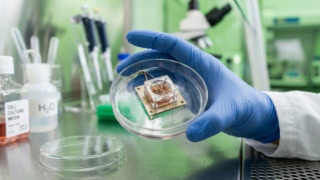
One of the most advanced examples is a biocomputer platform called CL1. Built by a research startup, it combines human neurons with a silicon chip and keeps the tissue alive in a nutrient rich chamber. The neurons fire electrical signals, adapt to inputs and display early signs of learning, acting as a biological processing unit.
Scientists believe biocomputers could eventually outperform traditional processors in pattern recognition, parallel processing and energy efficiency. Human neural tissue naturally excels at these tasks, while conventional chips and artificial intelligence systems require massive computational power to mimic similar behavior.
Early applications include drug discovery, disease modelling and neuroscience experiments. Because the cells are human derived, biocomputers may help researchers simulate brain activity, study neurological disorders and explore new forms of adaptive computing.
Despite promising results, the technology is still in its experimental phase. Scientists face challenges such as maintaining long term cell health, scaling the systems beyond small organoids, improving the biological electronic interface and addressing ethical questions around the use of living human tissue in machines.
Even so, the rapid pace of development suggests that biocomputers could redefine the future of computing. Instead of relying solely on silicon, the next generation of machines may be built with living cells that think, adapt and learn in ways traditional hardware never could.