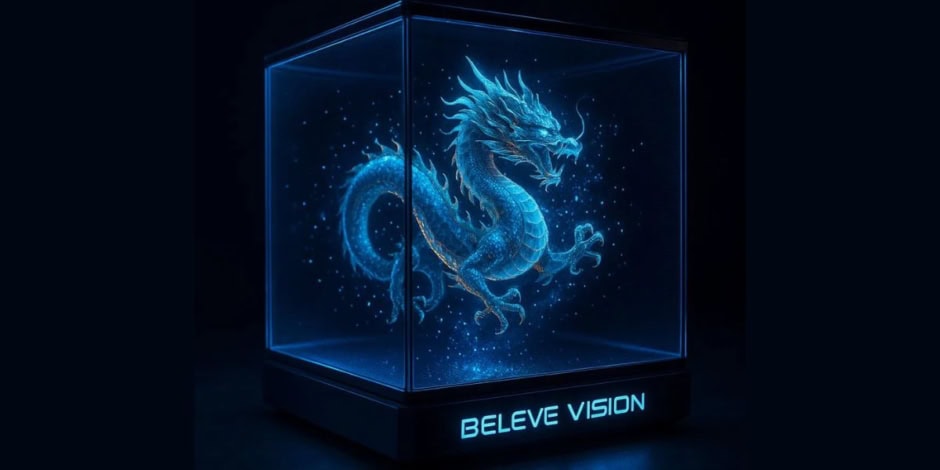
A striking breakthrough in VR is making waves as Portalgraph, developed by Beleve Vision, lets ordinary displays become immersive 3D visual portals with no headset required. Instead of isolating users from their surroundings, Portalgraph layers virtual content over real space, allowing people to see both their environment and holographic media simultaneously.
From Displays to Dimensions

Portalgraph works by converting standard screens such as TVs, monitors, projectors, and tablets into VR environments using software that projects depth and layering. The system supports combining multiple screens to craft projectable environments, turning desktops, tabletop displays, or 3D TVs into interactive spatial scenes. It is engineered to be compact, lightweight, and affordable, designed to feel as unobtrusive as a hat or glasses, while preserving full awareness of the real world.
One technical highlight is that the platform seamlessly drops Portalgraph assets into Unity scenes, making it easier for developers to open a portal to another dimension from existing game or visualization content. Because it operates in a latent virtual overlay rather than replacing the display entirely, it avoids the issues of visual discomfort or blocked vision common with VR headsets.
Real World Use and Public Appearances
Portalgraph has already appeared in multiple public demonstrations and competitions. It participated in the Knowledge Capital Workshop Festival 2025 and is scheduled for a VTuber 1 on 1 photo and high five event in November. It is also planning an immersive para equestrian exhibition for October 2025 during the Sports Festival, highlighting how the tech can project complex spatial visuals in a live setting.
What Makes Portalgraph Stand Out

Unlike conventional VR headsets, Portalgraph preserves the user’s field of view. The company claims a 100 degree projection field, potentially outpacing the viewing window of many commercial headsets, while maintaining a sense of depth and immersion. The system is designed to be socially acceptable with no bulky headgear and no visual isolation, making it a possible bridge between AR VR and regular media interaction.
Portalgraph has already earned accolades including the TGS Audience Award Grand Prix, XR Creative Awards, and multiple innovation recognition badges.
Challenges and What to Watch
Key questions remain about how Portalgraph handles motion, latency, and real world lighting. While layering virtual content over real scenes is promising, real time alignment and handling fast movements may present hurdles. Also, the current stated support for Unity scenes suggests developers will need to adopt specific pipelines or adapt existing content.
How Portalgraph scales, how content developers adopt it, and how consumer pricing holds will determine whether this technology becomes a mainstream path to VR or remains a niche experiment for spatial display enthusiasts.