While the world races to turn the climate crisis into an opportunity, from Norway’s solar cities to China’s massive battery farms, Pakistan is losing pace in clean energy adoption. For years, the message has been clear: Go Green, reduce carbon footprint. Many took the challenge seriously, investing their own money, installing panels, and effectively subsidizing the state by cutting fuel imports.
But in 2025, the promise of Net Metering gave way to Net Billing, and with it, the dream of Energy Democracy began to fade. Suddenly, the sun comes with a price tag, and households that once felt empowered now face reduced savings, confusing tariffs, and a system that seems designed to protect old power contracts rather than the people who were ready to embrace the future.
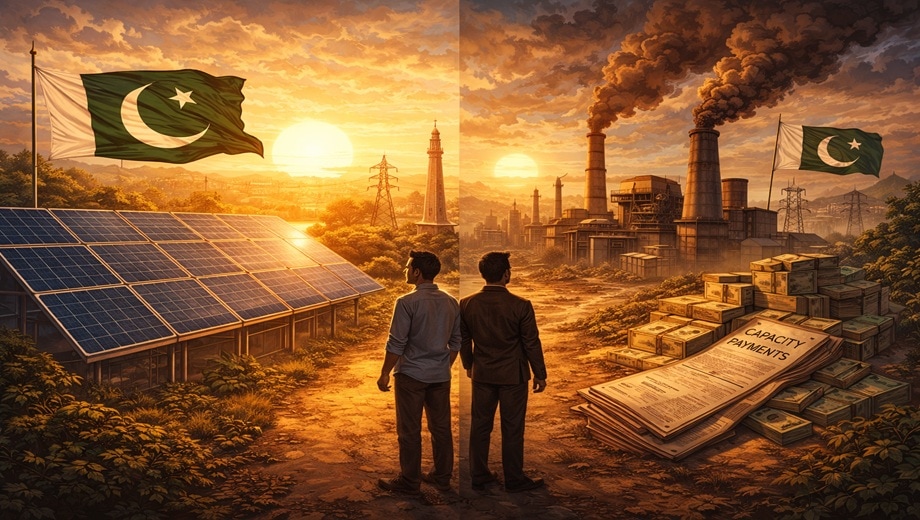
If Brazil can safeguard its solar users and Kenya can run industries on renewable energy, Pakistan’s struggle isn’t a fate but a a policy choice, one that pits the middle class against idle power plants and puts the country’s green ambitions at a crossroads.
Global Green Milestones
| Country | Key Achievements | Green Energy Share |
|---|---|---|
| Norway | 98% EV market share; petrol cars are now rare | approx. 98% (Mostly Hydro) |
| China | 1.2 TW of solar installed; added 315 GW in 2025 alone | approx. 60% (Non-fossil capacity) |
| Denmark | 88% renewables; world leader in wind-to-grid integration | 88% |
| India | 50% non-fossil capacity; reached target 5 years early | 50% |
| Germany | Record solar adoption; 100k panels/day installed in 2025 | 55% |
| Brazil | Added 9.1 GW of new capacity in 2026, net-metering law protecting distributed solar | approx. 87.5% |
| Kenya | Africa’s geothermal leader; on track for 100% renewable grid by 2030 | approx. 93% |
Where Pakistan Stands
Pakistan’s approach to renewable energy reflects a quiet contradiction. On global forums, the country often presents itself as a victim of climate change and committed to a green future. At home, however, that vision clashes with an energy system anchored in long-term contracts with Independent Power Producers (IPPs). As rooftop solar expanded, largely driven by citizens rather than state planning, it began to expose this structural imbalance.
Instead of adapting the grid to absorb distributed clean energy, new policy bends more toward protecting legacy commitments, creating the impression that renewable adoption is being managed not as a national asset, but as a financial complication. If progress is possible elsewhere, what keeps Pakistan standing still?
The IPP Elephant in the Room
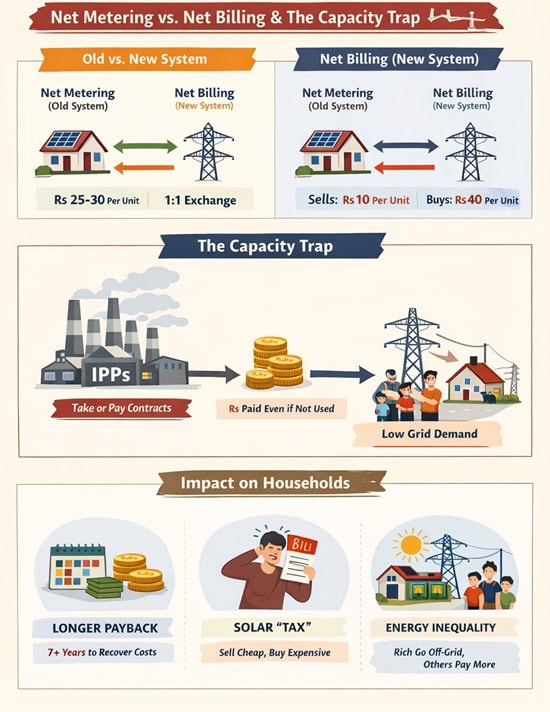
Pakistan’s reliance on Independent Power Producers (IPPs) creates a “Capacity Trap.” The Government remains bound by long-term Take-or-Pay agreements with Independent Power Producers (IPPs). Consumers continue paying capacity charges regardless of actual electricity consumption.. As over a half million homes have shifted to solar and started relying on national grid, the demand for grid electricity plummeted. But the bill for the IPPs stayed the same.
After years of promising clean energy independence, the shift from net metering to net billing has left many wondering if they’ve been punished for going green. the old system allowed solar users to enjoy a simple and fair deal, a 1:1 exchange. Every unit of electricity you exported to the grid was credited against the power you later consumed. If you gave a kilowatt-hour, you got a kilowatt-hour back. This symmetry turned the national grid into what many affectionately called a “National Battery.”
It was a fair trade. But the government quickly realized that fair trades don’t pay for idle power plants. Now, under Net Billing, the exchange rate looks like something out of the world. The exported electricity is purchased at a much lower wholesale rate, approx. Rs. 10- 11/unit), while grid electricity costs Rs. 37- 55/unit. In effect, households sell cheap and buy expensive.
To put it simply, you sell your surplus solar power to the grid at the price of a cup of tea, only to buy it back a few hours later at the price of a full meal. It’s a retail heartbreak that has extended the Return on Investment (ROI) from a 3 years to challenging 7 years.
The irony is that government is essentially penalizing the middle class for being efficient because they need their money to pay for idle power plants.
A Growing Energy Divide
The real problem of this net billing policy is the energy inequality. Industrial and high-income consumers are more likely to expand hybrid or fully off-grid systems. If they go fully off-grid, they will definitely leave the grid and its bills behind for others to worry. On the other hand, middle class is going to be left in net billing limbo. Their years of savings and planning now no longer delivers the promise and they are left in disillusionment. The third ones, the class that cannot afford the solar will pay the highest price. The will be now responsible to pay the capacity charges of the IPPs and those who escaped the situation.
The shift from net metering to net billing may well be inevitable, but its execution will determine whether it accelerates progress or punishes participation. If Pakistan is serious about its energy transition, solar adopters must be treated not as profit seekers, but as partners in national energy security. That means confronting the structural constraints head-on, from renegotiating legacy IPP capacity obligations to lowering battery import duties and making storage more accessible.
The promise of going green was never just environmental. It was economic, civic, and generational. Preserving that promise requires policy that rewards efficiency rather than disincentivizes it, ensuring that the citizens who invested in the country’s energy future are not left carrying the cost of its past.