
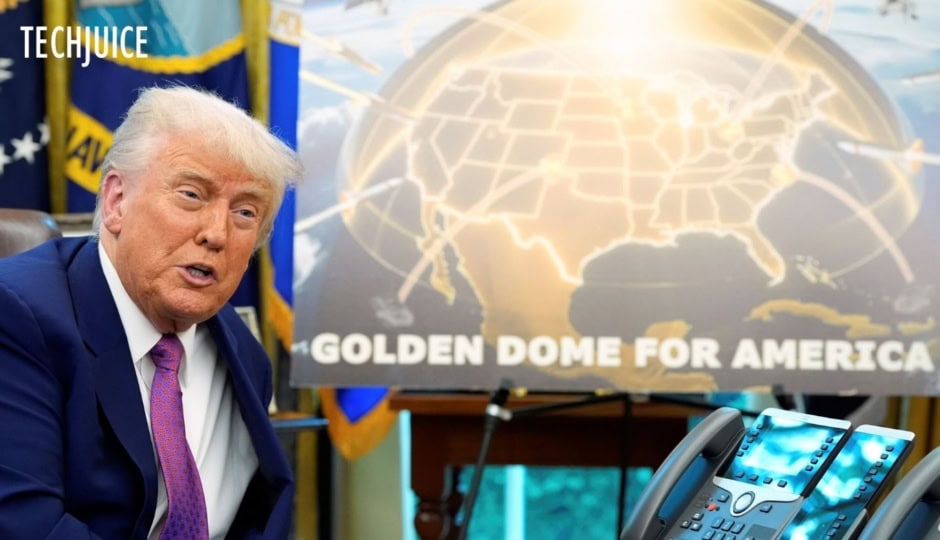
U.S. President Donald Trump has unveiled a bold initiative to construct a state-of-the-art missile defense system dubbed the “Golden Dome.” The plan, which Trump wants “fully operational before the end of my term,” is estimated to cost $175 billion, with $25 billion proposed in an ongoing tax-cut and spending bill.

Addressing reporters at the White House and later in the Oval Office, Trump emphasized the urgency and scope of the project.
He said, “In the campaign I promised the American people I would build a cutting-edge missile defense shield,” and stressed its importance, calling it “very important for the success and even survival of our country.”
What does the Golden Dome aim to do?
Unlike any previous missile defense system, the Golden Dome is envisioned as a space-based shield capable of defending the U.S. from a range of threats, including ballistic, cruise, hypersonic missiles, and drones. Pentagon chief Pete Hegseth, who appeared alongside Trump, explained that the system’s goal is to guard “the homeland from cruise missiles, ballistic missiles, hypersonic missiles, drones, whether they’re conventional or nuclear.”
According to Trump, the shield would intercept missiles “even if they are launched from other sides of the world, and even if they are launched from space.”
The system is expected to integrate next-generation technologies across land, sea, and space. It will be supported by a vast network of satellites for tracking and interception.
The name “Golden Dome” draws inspiration from Israel’s Iron Dome, a proven defense system against short-range rockets. However, experts point out that the scale of Trump’s plan is vastly more ambitious. It aims to cover a nation nearly 450 times the size of Israel and deal with far more advanced missile threats.
The initiative will be led by Gen. Michael A. Guetlein, vice chief of space operations at the U.S. Space Force.
Interest from Canada and Industry Giants
Trump also revealed that “Canada has called us” to express interest in participating in the project. Canadian Prime Minister Mark Carney is reportedly in talks with U.S. officials about expanding NORAD cooperation and possibly including Canada under the Golden Dome umbrella.
Major players in the defense and tech industries, including SpaceX, Palantir, and Anduril, are already competing for contracts. Elon Musk’s SpaceX is seen as a frontrunner in building key system components.
Rising Skepticism and Global Concern
Despite the grand vision, the project has sparked both domestic and international concerns. Critics within the U.S., especially from the Democratic Party, have raised concerns about the plan’s feasibility and transparency. They are particularly worried about potential favoritism in contractor selection due to Trump’s close ties with Musk.
Military experts have also cast doubt on the administration’s timeline and budget. Trump says the shield could be ready in three years. But some analysts disagree. Retired Rear Adm. Mark Montgomery believes it might take 7 to 10 years. Even then, it may only protect key infrastructure and major cities.
Global powers like Russia and China have sharply criticized the project. Beijing called the initiative “a strong offensive nature” and warned it could escalate the militarization of space. Russia labeled the plan “deeply destabilizing” and suggested it could turn space into a “battlefield.”
A Kremlin statement emphasized that the system “explicitly provides for a significant strengthening of the arsenal for conducting combat operations in space.”
Long-Term Implications
The U.S. has long debated building a missile shield, but previous efforts have been hindered by technological limitations and high costs. Trump’s proposal may be the boldest yet, but it also risks intensifying global tensions.
As of now, the White House claims it has “selected an architecture for this state-of-the-art system,” but many details remain undisclosed.
What’s certain is that the Golden Dome represents a pivotal moment in U.S. defense strategy—one that could shape global military dynamics for decades to come.